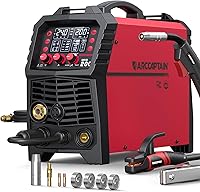
What Is a Multiprocess Welder?
A multiprocess welder is one power unit that runs several welding processes, usually MIG, flux core, TIG and stick, by switching modes instead of buying separate machines. It saves floor space and money for home shops that need more than one process.
On this page (8 sections)
- What is a multiprocess welder and how does it work?
- What processes does a multiprocess welder cover?
- Which welding processes do you actually need at home?
- What does a multiprocess welder cost in power and space?
- How do you switch between modes on one machine?
- Which multiprocess welder fits a first home project?
- What are the limits of a multiprocess welder?
- How do you choose your first multiprocess welder?
A multiprocess welder is one power unit that runs several welding processes, usually MIG, flux core, TIG and stick, by switching modes instead of buying separate machines. It saves floor space and money for home shops that need more than one process.
The trade is that each mode runs within the machine's overall power limit. Understanding what a multiprocess welder actually combines helps you pick the right one for the work you have in front of you.
What is a multiprocess welder and how does it work?
It's a single box with one power supply, one wire feeder and switchable output for different welding processes. You change the mode, swap the torch or lead, and set the controls for that process.
Inside, the unit shares its transformer or inverter, its wire drive and its gas solenoid across the modes. MIG uses the wire feeder and a shielding gas.
Flux core uses the wire feeder without gas. TIG needs a separate torch and usually argon.
Stick runs an electrode holder and flux-coated rods.
That shared hardware is why the machine costs less and takes less bench space than four separate welders. The limit is that the power supply has to serve every mode, so the amps in TIG or stick may be lower than what a dedicated machine offers.
Most home units run on 120V or 240V. A dual-voltage model gives you more output on 240V while staying usable on a standard outlet.
Machines that run on 120V usually ship with a plug adaptor so you can use a household circuit without rewiring a garage outlet.
What processes does a multiprocess welder cover?
The typical set is MIG, flux core, TIG and stick, though not every machine includes all four. Some add a spool gun for aluminum MIG, and some include AC TIG for thicker aluminum work.
Here's what each mode is for:
- MIG (GMAW): wire feed with shielding gas. The everyday choice for thin steel sheet, auto body panels and clean fabrication.
- Flux core (FCAW): wire feed without gas. Works outdoors or in a breeze where gas would blow away.
- TIG (GTAW): a tungsten electrode and separate filler rod. Slow and precise, good for thin metal and visible joints.
- Stick (SMAW): flux-coated rods. Forgiving on dirty or rusty steel and on thicker material.
- Spool gun: feeds soft aluminum wire over a short distance. The common way to MIG weld aluminum at home.
Some machines go further than the basics. The Weldpro Omni 210 covers MIG, stick, AC/DC TIG, spool gun and flux core in one machine, with HF or Lift arc starting and adjustable post flow for TIG.
That's a wide spread for a home shop.
Which welding processes do you actually need at home?
Pick the process your projects use most, then check the machine also covers your second one. Most home welders start with MIG or flux core and add TIG or stick later.
MIG suits thinner steel, which is most of what a home shop touches. Flux core needs no gas bottle, so it's the easiest start.
Stick handles thicker, dirtier metal such as gate repairs and trailer frames, and hot start and arc force settings on a stick-capable machine make those rods easier to strike and hold. TIG is the slow, clean option for visible work on thin steel or stainless.
If you only ever weld 1/8 inch steel in the garage, a single-process MIG welder may do everything you need. A multiprocess unit earns its keep when your projects vary, or when you want one machine to grow into.
What does a multiprocess welder cost in power and space?
You get one footprint and one input cable instead of four machines, but each process runs at the machine's shared output rating. That's the main thing to weigh before buying.
A 120V multiprocess welder typically runs modest amperage across all modes. A 240V or dual-voltage model reaches higher amps and a longer duty cycle.
Higher amps mean thicker metal and longer welds before the machine needs to cool.
Space matters as much as power. One unit with one cart and one gas bottle is easier to store than a MIG box and a TIG box side by side.
For a home garage, that's often the deciding factor.
Weight is part of the same trade. The Forney unit here weighs about 26 pounds, the Miller about 51 pounds and the Weldpro about 82 pounds, so the bigger the machine, the more you want it on a cart or a fixed bench.
How do you switch between modes on one machine?
You select the process on the front panel, then swap the torch or lead and set the gas and polarity for that mode. Most machines use a simple selector switch and separate controls for voltage and wire speed.
The Forney Easy Weld 140 MP illustrates the idea well. It's a 3-in-1 stick, MIG and DC TIG machine with a 3-position switch for quick process changes.
Infinite voltage and wire feed speed adjustments let you dial in the weld, and it runs on a 120V power source.
The all-metal case is built to take daily shop use. The kit includes a 10 foot MIG gun, an 8 foot electrode holder, an 8 foot ground clamp, a 20amp-15amp adaptor and a spare .030 inch contact tip.
Before each switch, check the polarity. MIG and flux core usually run opposite polarity to each other, and stick and TIG differ too.
Getting this wrong gives poor arcs and spatter.
Do you need a separate torch for TIG?
On most combo machines, yes. The MIG gun and the TIG torch are different tools, so TIG mode means unplugging one and fitting the other along with its gas line.
Some machines list TIG in the name but offer the torch as an option, so check what ships in the box.
Which multiprocess welder fits a first home project?
Start with the process you'll use most and the power your outlet can supply. A 120V machine is the low-friction choice for a garage with only standard outlets.
A dual-voltage unit gives room to grow.
The Miller Multimatic 215 PRO is the most capable of the three here. It runs MIG, pulsed MIG, TIG, pulsed TIG and stick, and the Multi-Voltage Plug connects to 120V or 240V without tools.
Miller says it MIG welds up to 3/8 in. on 240V or 3/16 in. on 120V. Auto-Set gives fast settings and BeadVision monitors the bead in real time.
It also handles 4 or 8 inch spools and comes with a 15 foot MIG gun. That reach helps on larger projects where you don't want to move the machine.
Program Memory saves your most-used settings, and USB software updates mean the machine can gain features after purchase. A Quick Select drive roll with three grooves and Quick Select drive rolls for solid or flux-cored wire cut the setup time when you change wire.
The Weldpro Omni 210 sits between the two. It offers MIG, stick, AC/DC TIG, spool gun and flux core across 110V and 220V, with synergic MIG and Auto-Set.
Its 6-in-1 spread covers aluminum work and heavier jobs in one unit.
Weldpro also equips it with a multi-function display, VRD, and a rocker-style foot pedal for TIG. The included 10 foot MIG torch and KT26 TIG torch with a trigger switch cover both of the modes most people will use first.
If aluminum is a big part of your plans, compare dedicated options in our guide to aluminum welders and read can you weld aluminum with a mig welder before you commit.
What are the limits of a multiprocess welder?
The main limits are shared output, process compromises and more setup steps. A dedicated machine usually beats a combo on its one process at the same price.
Shared output means the amps are split across modes. A combo's TIG mode may be weaker than a dedicated TIG box.
The wire feeder is set up for MIG, so switching to TIG means changing the torch and gas.
Setup takes more steps than a single-purpose machine. You'll manage gas, polarity, torch changes and settings for each process.
That's fine once you know the drill, but it slows a beginner at first.
Combo units also vary in what they include. Some list TIG in the name but need an optional torch.
Check the process list and what ships in the box before you buy.
How do you choose your first multiprocess welder?
Match the process list and input voltage to your projects and outlet, then confirm the machine runs the modes you'll actually use. Don't buy extra modes you'll never touch.
Use these rules:
- Pick a 120V unit if your garage only has standard outlets and you weld thin steel.
- Pick a dual-voltage or 240V unit if you want thicker metal and longer welds.
- Pick a model with a spool gun or AC TIG if aluminum is on your list.
- Pick a brand with a clear accessory path if you'll add a TIG torch later.
A multiprocess welder makes the most sense when your work varies. If it doesn't, a single-process machine will serve you well and cost less.
When you're ready to compare models side by side, our multi process welder roundup covers the picks worth a closer look.
Frequently asked questions
Can a multiprocess welder run all four processes at full power?
Usually not. Most units are limited by their input voltage, so 120V models cap out lower than 240V models.
Check the amp rating for each process you plan to use, because TIG and stick often run at different amperage than MIG on the same machine.
Do I need gas for every process on a multiprocess welder?
No. Flux core welding runs without shielding gas, and some stick setups need none either.
MIG and TIG normally need a cylinder of the right gas, so budget for a regulator and bottle if those modes matter to you.
Is a multiprocess welder hard for a beginner to learn?
It's about as hard as learning each process on its own machine. The advantage is one set of controls and one spot in the shop.
Pick the process you'll use most first, such as MIG for thin steel, and add TIG or stick practice later.
Can a multiprocess welder weld aluminum?
Some can, but only if the machine supports it. Spool gun MIG or AC TIG are the usual routes to aluminum, and not every unit offers either one.
Check that the model you're considering names aluminum as a supported material.
What's the difference between a multiprocess welder and a multi-voltage welder?
Multi-process refers to the welding modes the machine can run. Multi-voltage means it accepts more than one input power level, such as 120V and 240V.
A good home unit often has both, but the two terms describe separate features.