Are Everlast Welders Any Good?
Yes, for many home users, but not for everyone. Everlast packs multi-process modes and digital controls into low-cost machines, while its long warranty terms and support have drawn more criticism than its welding basics.
On this page (8 sections)
- What are Everlast welders known for?
- Are Everlast welders good for beginners?
- What do owners praise and criticize about them?
- How do Everlast welders compare with big brands like Lincoln and Miller?
- Are Everlast welders reliable?
- Is a multi-process Everlast worth it over a single-process welder?
- How should you choose the right Everlast model?
- So, are Everlast welders any good for your project?
The short answer to "are everlast welders any good" is yes for value and features, less so for simple no-fuss ownership. Everlast welders are inverter machines sold direct online, with multi-process modes and digital controls at prices below name-brand units.
The weak spot people mention most is after-sale support and warranty service, so whether one suits you depends on what you value.
This guide weighs the real strengths and trade-offs of Everlast welders for home shops. It also covers when a well-supported mainstream machine is the safer buy, and how to check the model you're considering.
What are Everlast welders known for?
Everlast is known for inexpensive inverter welders with big feature lists. Most models run multi-process setups: MIG, flux-core, stick and TIG in one box.
Many include digital displays and synergic controls that set wire feed and voltage for you.
A typical home user gets four welding processes from one machine for less than a single-process name-brand unit costs.
The trade-off sits in the business model. Everlast sells direct, so there's no dealer network, no local store to walk into and no technician down the street.
That keeps prices low but pushes service into shipping and phone or email support. The welding itself gets fair reviews; the ownership experience is where the two sides split.
Buyers who like tinkering and reading manuals do well, while people who want plug-and-play reliability with easy returns lean elsewhere.
Are Everlast welders good for beginners?
They can be, if you pick a simple synergic model and practice on scrap. Digital controls reduce guesswork, so a first-time welder isn't lost adjusting wire speed and voltage by feel.
The multi-process capability also means one machine covers flux-core practice, stick work and later TIG without buying again.
The risk for beginners is the settings volume. Inverter units expose more parameters, so a model with a big menu can overwhelm someone who just wants to join two pieces of steel.
A unit with preset synergic mode handles that. The other beginner concern is support: when your first beads go wrong, a mainstream brand with a local dealer or a fast phone line is easier to lean on.
If you're teaching yourself from videos and forums, Everlast's value works in your favor. If you want hand-holding, choose a simpler machine from a widely supported brand.
What do owners praise and criticize about them?
Owners tend to praise the arc quality and the price, and criticize support speed and warranty handling. The welding performance lands well for the money: stable arcs, good duty cycles on mid-size units and plenty of process modes.
Many say a multi-process Everlast handles 90 percent of home projects, including thicker steel on the 230V setting.
The friction comes after the sale. Common criticisms center on slow responses, unclear warranty steps and the cost of return shipping if a unit fails.
That doesn't mean the machines are unreliable; it means the support path is thinner. Buyers who value a local store and easy returns are better served by brands sold through dealers.
Buyers comfortable with direct-online service get a lot of welding capability per dollar. For a fair comparison of what "good" looks like on the mainstream side, see our ARCCAPTAIN MIG200 review, which covers the same budget multi-process space.
How do Everlast welders compare with big brands like Lincoln and Miller?
Everlast undercuts Lincoln and Miller on price for the same process count, but gives up dealer support and brand history. A multi-process Everlast often costs less than a single-process unit from Lincoln or Miller.
Its inverter design and digital display also match features that cost more elsewhere.
What the big brands bring is a dealer network, decades of documented reliability and quick access to parts. The Lincoln Electric Square Wave 205 shows that difference in a TIG machine: it's a dedicated AC/DC TIG and stick unit with adjustable AC frequency and balance for aluminum work.
Its price and support structure are set for buyers who want a long-lived machine backed by a known name.
For a home fabricator welding mostly steel, an Everlast multi-process unit delivers more capability per dollar. For someone welding aluminum regularly who wants a machine built to last and serviced locally, the Square Wave 205 is the safer long-term pick.
The question is whether you'd rather pay less up front or pay more for support you can reach easily.
Are Everlast welders reliable?
The hardware is generally reliable; the weak link is service when something does go wrong. Inverter welders from budget brands share components, and Everlast's mid-size units have a decent record for hobby and light-shop work.
Failures do happen, as with any inverter, and the repair path matters more than the failure rate.
That's why the honest answer depends on your risk tolerance. If a dead unit means a slow repair process, that's a real cost.
A buyer with a backup or a light workload feels it less. Reliability also depends on how hard you run the machine: staying within its duty cycle and avoiding extended high-amp sessions protects an inverter.
Our guide to what duty cycle means on a welder explains why the rated percentage matters more than the peak amps on the box. A 60 percent duty cycle at 165A, as the ARCCAPTAIN 165A lists, is workable for home projects but limits long continuous runs.
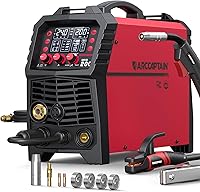
That ARCCAPTAIN unit covers gas and gasless MIG, stick and lift TIG in one box and handles mild steel up to 3/16 inch thick. It's the sort of machine a beginner might compare against a comparable Everlast.
The welding capability is there; the support question is what separates them. If you want a mainstream alternative in the same multi-process format, this is a useful benchmark.
Is a multi-process Everlast worth it over a single-process welder?
Yes, if you'll genuinely switch between MIG, stick and TIG. A multi-process machine replaces two or three separate units, saves bench space and lets you choose the process for the job.
For a home shop welding steel brackets, doing occasional stick repairs and learning TIG, one box makes sense.
The catch is that multi-process units usually need a separate TIG torch. The ARCCAPTAIN 165A requires a WP-17V torch bought on its own.
Factor that into the budget. A single-process machine often gives more output for the same money, so compare rated amps and duty cycle rather than process count alone.
If you only ever flux-core weld thin steel, a dedicated MIG box is simpler and often cheaper. If you want to grow into stick and TIG without buying again, multi-process earns its keep.
The best fit is a unit whose synergic modes keep setup simple, so the extra processes don't become extra confusion.
How should you choose the right Everlast model?
Start from the process you'll use most and the outlet you have. Every model has a rated output and duty cycle at that output, and that combination decides what projects it can handle.
Pick the process first: flux-core MIG for thin steel, stick for thicker and outdoor work, TIG for precision and aluminum.
Then match voltage to your shop.
If your only outlet is 120V, choose a dual-voltage or 120V-only unit and accept lower output on household power. A 120V 135A flux-core machine like the ARCCAPTAIN 135A covers sheet metal and light fabrication on a standard outlet.
A 230V unit gives more amps for thicker material. Aluminum TIG also needs AC output and a foot pedal for good results, so check that feature before buying.
Our guide to aluminum welders covers what that process demands.
The 135A lists automatic voltage and wire-speed matching when you enter wire size and metal thickness, which keeps a first-time setup simple. If you're weighing a small Everlast against it, compare duty cycle and process count at the same price.
Duty cycle is the number that predicts whether the machine will keep up on a long project. For a beginner welding thin steel on a 120V outlet, a synergic flux-core machine is the sensible starting point.
So, are Everlast welders any good for your project?
They're good value for a home shop that wants multi-process capability and doesn't mind direct-online support. Pick Everlast when the price-to-feature ratio matters most and you'll handle setup and service yourself.
Skip it when local dealer support, fast returns or a long service history are priorities, and choose a mainstream brand instead.
For a first welder on household power doing light steel work, the ARCCAPTAIN 135A is a straightforward, well-supported option. For more processes and thicker steel, the ARCCAPTAIN 165A covers gasless and gas MIG, stick and lift TIG in one dual-voltage unit.
For dedicated aluminum TIG with name-brand backing, the Lincoln Electric Square Wave 205 is the long-term pick. That comparison is the real test of whether Everlast welders are good enough for you.
If you're still deciding which process fits your project, read what a MIG welder is good for before you buy.
Frequently asked questions
Does Everlast make welders in the USA?
No. Everlast machines are made overseas and sold direct through its own online store, which is one reason its prices undercut name-brand units sold through dealers.
That direct-sales model also shapes its return and support process.
What warranty do Everlast welders carry?
Everlast advertises multi-year warranties on its machines, though the terms differ by model and often cover parts differently from labor. Read the specific warranty text for the welder you plan to buy before ordering.
Can an Everlast welder run on household 120V power?
Some models offer dual-voltage 120V/230V input or 120V-only operation, while larger units need 230V. Match the model to your outlet, and expect lower output on 120V than the same machine delivers on 230V.
Are Everlast welders worth it compared with Harbor Freight?
Everlast tends to offer more process modes and digital controls per dollar than budget store brands. Harbor Freight units are easier to buy and return locally, so the better fit depends on whether you value features or local support more.