What Is a MIG Welder Good For?
A MIG welder is good for fast, clean joining of thin to medium steel and aluminum, which is why it suits auto body panels, furniture, gates, and light fabrication. It's the easiest process for a beginner to learn on flat and horizontal work.
On this page (9 sections)
- What jobs is a MIG welder good for?
- What metals and thicknesses does MIG handle best?
- When should you choose flux core instead of gas MIG?
- What should a beginner look for in a first MIG welder?
- Which MIG welder suits light sheet metal and auto body work?
- Where does a MIG welder fall short?
- What safety gear do you need before you strike an arc?
- How do you get started with MIG welding?
- So, what is a MIG welder good for in a home shop?
A MIG welder is good for fast, clean joining of thin to medium steel and aluminum, which is why it suits auto body panels, furniture, gates, and light fabrication. It's the easiest process for a beginner to learn on flat and horizontal work.
The machine feeds a wire electrode that melts into the joint while shielding gas or flux core protects the puddle. That setup lets you weld continuously instead of stopping to change a stick.
The short answer for a home buyer is that MIG covers most light metal repair jobs well and struggles with very thick or very dirty metal. Below is where it fits, where it doesn't, and which machine to start with.
What jobs is a MIG welder good for?
MIG is good for thin to medium steel work done flat or horizontal, from auto body panels to garden furniture and light trailer repairs. The wire feed keeps the arc steady, so you can run long beads without stopping.
That makes it the go-to process for sheet metal and small fabrication.
Typical jobs include lawn mower decks, gate hinges, bench frames, exhaust brackets, and patch panels on a car. On 1/8 inch steel a 110V machine runs comfortably.
On 3/16 inch it still works with a slower travel speed. Anything much thicker usually calls for a 220V unit or a different process.
For a closer look at home setups, see our roundup of the best MIG welder for home use.
What metals and thicknesses does MIG handle best?
MIG handles mild steel best, then stainless and aluminum, with the right wire and gas for each. Mild steel is the easiest and the most forgiving.
Stainless needs a matching filler wire and a slightly different gas mix. Aluminum needs argon gas and a spool gun or a short torch lead because the wire is soft.
Thickness matters more than metal type. A 110V machine tops out around 3/16 inch on mild steel.
A 220V machine reaches thicker plate. Thin sheet under 1/16 inch needs low current and a slow wire speed so you don't blow holes.
Check the maker's thickness rating before you buy and match it to the jobs you have in mind.
When should you choose flux core instead of gas MIG?
Choose flux core when you weld outdoors or in wind, because the flux inside the wire shields the puddle without a gas bottle. Gas MIG gives cleaner welds with less spatter, but a breeze blows the shielding gas away.
That's the main reason many home welders start gasless.
Flux core leaves slag you chip off after each pass. It also runs hotter and spatters more on thin sheet.
For indoor bench work on clean steel, gas MIG is the better finish. For fence repairs in the yard or a windy driveway, flux core saves the hassle of dragging a cylinder around.
Our guide to MIG vs flux core welders breaks down the gas and gasless choice.
What should a beginner look for in a first MIG welder?
Look for a 110V machine with a synergic control, a clear display, and a duty cycle that matches your pace. Synergic mode matches voltage to wire speed for you, which takes most of the guesswork out of the first few beads.
A digital screen helps you read settings without lifting your helmet.
Duty cycle tells you how long you can weld before the machine needs to cool.
Weight matters if you'll carry the unit to a job. A 12 to 13 lb machine is easy to move; a heavier transformer unit stays put.
Check the wire spool size too, since some small units only take a 2 lb spool. If you're working to a budget, our roundup of the best MIG welders under 500 covers the value end of the market.
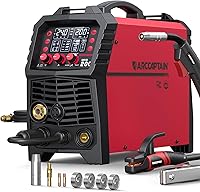
The ARCCAPTAIN 165A runs gas MIG, flux core, stick, and lift TIG, though the TIG torch is sold separately. It has a 165A output, a 60% duty cycle, and handles mild steel up to 3/16 inch thick.
The dual voltage design lets you switch to 220V when you have the outlet. It weighs about 12.8 lb and holds a 2 lb spool.
Which MIG welder suits light sheet metal and auto body work?
A lower-amp 110V unit with synergic control is the better fit for thin sheet, because it lets you dial down the current to avoid burn-through. Auto body panels are often 20 to 22 gauge, so fine control matters more than raw power.
A 135A machine on low settings gives you that margin.
The YESWELDER 135A is a gasless flux core unit with a 135A output on 110V. It handles mild steel up to 3/32 inch thick.
The synergic control matches voltage to wire feed speed, and a plus or minus 3V micro-adjustment lets you trim the arc. It weighs 11.4 lb and runs flux core MIG, stick, and lift TIG with an extra torch.
For a deeper look at this class of machine, read our YESWELDER 160A review.
Where does a MIG welder fall short?
MIG struggles with thick plate, dirty metal, and overhead or vertical work in untrained hands. A 110V machine can't fuse thick steel in one pass.
Rust, paint, and oil cause porosity, so the metal needs cleaning first.
Out-of-position welding takes more practice than flat work because gravity pulls the puddle.
Cast iron is a poor fit for MIG. Stick welding handles thick and dirty steel better.
TIG gives finer control on thin stainless and aluminum. MIG also needs more consumables than stick: wire, gas, tips, and liners all wear.
None of that makes it a bad choice. It just means you match the process to the job.
What safety gear do you need before you strike an arc?
You need an auto-darkening helmet, gloves, a jacket, and good ventilation before any welding starts. An arc flash can damage your eyes in seconds, so the helmet comes first.
A fixed-shade helmet works but forces you to lift it between passes. An auto-darkening lens darkens the moment the arc strikes.
The Hobart 770890 has a 9.3 inch widescreen viewing area and four arc sensors. It offers continuous UV and IR protection and switches to grind mode so the lens stays clear during grinding.
It runs on one CR2 battery, which is included. The shade, sensitivity, and delay settings adjust with analog knobs.
It weighs 1.25 lb.
How do you get started with MIG welding?
Start on scrap steel the same thickness as your real job, running short beads until the arc sounds steady and the bead sits flat. Set the voltage and wire speed to the maker's chart for that thickness, then adjust one setting at a time.
Keep the gun angled about 10 to 15 degrees and move at a steady pace. Clean the metal first, since rust and paint ruin a weld faster than a wrong setting.
Practice flat beads before trying vertical or overhead work. Check your duty cycle so you don't overheat the machine on long runs.
Keep the tip and liner clean, and replace a worn tip before it causes feed problems.
So, what is a MIG welder good for in a home shop?
A MIG welder is good for light steel and aluminum repair, hobby fabrication, and auto body work, and it's the process most beginners should learn first. Pick a 110V machine if your jobs are thin sheet and you weld indoors.
Pick a dual-voltage unit if you want room to grow into thicker steel. Add a gas kit for cleaner welds and a good helmet before anything else.
Start on scrap, keep your metal clean, and match the wire and gas to the metal. That's the whole answer to what a MIG welder is good for, and it covers most home jobs you'll meet.
Frequently asked questions
What is a MIG welder good for around the home?
It's good for thin steel jobs like lawn mower decks, trailer frames, gate hinges, and furniture repairs. It also handles auto body work and light aluminum with the right wire and gas.
It's less suited to very thick steel or dirty, rusty metal.
Can a MIG welder weld aluminum?
Yes, with a spool gun or a push-pull torch and aluminum wire plus argon gas. A standard MIG setup with a short torch lead can feed aluminum wire for light work.
Very thin aluminum still takes practice because the wire is soft and kinks easily.
Is MIG welding easy for beginners?
It's the easiest common process to learn because the wire feeds itself and you steer the gun. You still need to set voltage and wire speed to match the metal thickness.
Most people get usable beads on flat steel after a few hours of practice.
What metals can a MIG welder join?
MIG joins carbon steel, stainless steel, and aluminum. It handles mild steel best, and stainless needs a matching filler wire.
Cast iron and dirty or painted metal are poor fits for MIG.
Do I need gas for MIG welding?
Gas MIG uses a shielding gas mix, usually argon and CO2, for clean welds on steel. Flux core MIG runs without gas and works better outdoors in wind.
Many home welders start gasless and add a gas kit later.
What thickness of steel can a MIG welder weld?
A typical 110V home MIG handles mild steel up to about 3/16 inch thick. A 220V machine reaches thicker plate.
Very thin sheet under 1/16 inch calls for low amperage and a slow wire speed to avoid burn-through.