9 Best MIG Welders for Home Use (October 2026)
The best MIG welders for home use include the Hobart Handler 210 MVP for a changing home shop, the Millermatic 211 PRO for control features, and the Lincoln Electric Power MIG 140MP for a named MIG model.
On this page (5 sections)
The Hobart Handler 210 MVP is the best MIG welder for home use if you want the option of 115V or 230V input. For small jobs on 120V power, the Lincoln Electric Weld-Pak 90i MIG is a portable option.
A home shop might mean occasional fence fixes, hobby projects or regular fabrication. Think about your available circuit, whether you want to use shielding gas and how often you need to move the welder before picking a model.
For a dedicated wire-feed machine, compare the MIG choices below. If you want TIG or stick capability too, the Forney Easy Weld 140 MP offers three processes in one machine.
Our picks at a glance
-
1

-
2

-
3

- 4
 Best for three welding processesCheck it
- 5
 Best for a traditional wire-feed setupCheck it
- 6
 Best for gas-free flux coreCheck it
- 7
 Check it
Lincoln Electric Weld-Pak 90i MIG
Best for portable MIG and flux core - 8
 Check it
Lincoln Electric Weld-Pak 90i FC
Best for portable flux core - 9
 Best for simple flux-core jobsCheck it
How we chose MIG welders for home use
We compared input power, welding processes, portability and features that matter in a home shop. Our score weighs specs, features and buyer feedback against what you're shopping for.
Match a welder to the power available where you plan to work. Follow the manufacturer’s setup and safety instructions.
Home use can range from occasional repairs to a dedicated work area. We included dual-voltage machines, portable 120V options and flux-core picks for readers who want to avoid shielding gas.
How do these home MIG welders compare?
Input power, supported processes and portability are the main differences among these home MIG welders. This table highlights details that can help narrow your choice.
| Product | Best for | Input power | Processes | Weight | Our score |
|---|---|---|---|---|---|
| Hobart Handler 210 MVP | a changing home shop | 115V or 230V | MIG and flux core | 79 lb | 9.0 |
| Millermatic 211 PRO | control features | 120V or 240V | MIG and flux core | 47.6 lb | 8.9 |
| Lincoln Electric Power MIG 140MP | a named MIG model | 8.8 | |||
| Forney Easy Weld 140 MP | three welding processes | 120V | MIG, DC TIG and stick | 25.8 lb | 8.6 |
| Lincoln Electric Easy MIG 140 | a traditional wire-feed setup | 120VAC | MIG and flux core | 62 lb | 8.5 |
| Forney Easy Weld 140 FC | gas-free flux core | 19 lb | 8.4 | ||
| Lincoln Electric Weld-Pak 90i MIG | portable MIG and flux core | 120V | MIG and flux core | 15 lb | 8.2 |
| Lincoln Electric Weld-Pak 90i FC | portable flux core | 120V | 15 lb | 8.3 | |
| Hobart Handler 125 | simple flux-core jobs | 120V | 63 lb | 8.0 |
The best MIG welders for home use
The highest-scoring models offer a mix of home-shop flexibility and useful features. Other picks focus on portability, flux-core work or small jobs.
Hobart Handler 210 MVP: Best for a changing home shop
- 115V or 230V input power
- MIG and flux-core ready
- Built-in gas solenoid valve and dual-gauge regulator
- Spool gun ready
Dual-voltage input gives you a choice between 115V and 230V power. It is also MIG and flux-core ready, with a built-in gas solenoid valve and dual-gauge regulator.
Pros
- Two input voltage options
- MIG and flux-core capability
- Spool gun ready
Cons
- Heaviest pick here
- Larger than compact small-job machines
The Hobart Handler 210 MVP is the highest-scoring pick for a home shop that may use either 115V or 230V power. Its multi-voltage plugs let you switch input options without additional tools.
Hobart describes it as MIG and flux-core ready, with an industrial cast aluminum wire drive and spool-gun readiness. It includes a built-in gas solenoid valve and dual-gauge regulator.
At 79 lb, it is the heaviest machine in this roundup. Consider its weight when choosing where to set it up.
Choose it if you want dual-voltage input and both MIG and flux-core options. If your work may include aluminum, see our guide to using a MIG welder for aluminum.
Millermatic 211 PRO: Best for control features
- 120V and 240V input
- Auto-Set and BeadVision
- Program Memory
- Spool gun detection
This dual-voltage machine combines Auto-Set, BeadVision and Program Memory. It supports mild steel, stainless steel, aluminum with a spool gun, and flux-cored wire.
Pros
- Two input voltage options
- Auto-Set and Program Memory
- Detects a connected spool gun
Cons
- More features to weigh against a simple home repair setup
- Confirm the power-source details with Miller before buying
The Millermatic 211 PRO pairs 120V and 240V input with features for setup and repeat work. Auto-Set simplifies setup, while Program Memory can save and recall weld parameters.
Miller says the machine supports mild steel, stainless steel, aluminum with a spool gun and flux-cored wire. BeadVision provides real-time bead monitoring, and the machine can detect a connected spool gun.
It weighs 47.6 lb and includes a 15 ft MIG gun. Miller describes the machine as using 120V and 240V input power.
Choose it if the control features fit your work and you want two input voltage options. For another way to compare capabilities in a home shop, read whether a multi-process welder is worth it.
Lincoln Electric Power MIG 140MP: Best for a named MIG model
- Lincoln Electric Power MIG 140MP model
- Product information identifies it as a MIG welder
This pick suits buyers who want a Lincoln Electric MIG machine and are comparing a named model. Confirm process options and input requirements for your planned work before choosing it.
Pros
- Lincoln Electric model
- Named Power MIG 140MP
Cons
- Available product information does not confirm input voltage or additional processes
- Check the current specifications before buying
The Lincoln Electric Power MIG 140MP is a named MIG model for buyers who prefer to compare welding brands. The K4498-1 model is identified as a MIG welder, but its input voltage and process options are not confirmed here.
Consider this pick alongside your specific job list. Check the model’s specifications and included equipment before choosing it.
Choose it if you want to consider this Lincoln Electric MIG model and can verify that its setup fits your home shop. For a more clearly specified 120V MIG and flux-core option, compare the Lincoln Electric Easy MIG 140 below.
Forney Easy Weld 140 MP: Best for three welding processes
- MIG, DC TIG and stick processes
- 120V power source
- Infinite voltage and wire-feed speed adjustment
- 25.8 lb
MIG, DC TIG and stick capability give this machine several roles in a home shop. It uses a 120V power source and has infinite voltage and wire-feed speed adjustments.
Pros
- Three processes in one machine
- Runs on 120V
- All-metal case
Cons
- Not a MIG-only machine
- The 140 MP model is not a fit if you only want a dedicated wire-feed welder
The Forney Easy Weld 140 MP is a 3-in-1 machine for MIG, DC TIG and stick welding. It uses a 120V power source and includes a 10 ft MIG gun, electrode holder and ground clamp.
Infinite voltage and wire-feed speed adjustments let you fine-tune the MIG setup. Its all-metal case and 25.8 lb weight make it a manageable choice if you want one machine for more than wire-feed welding.
Choose it if you want TIG and stick options alongside MIG in a home shop. If you plan to stay with MIG, a dedicated wire-feed model may be simpler to compare.
Lincoln Electric Easy MIG 140: Best for a traditional wire-feed setup
- MIG and flux-core processes
- 120VAC input
- 30–140A output range
- 50–500 IPM wire-feed speed control
This Lincoln Electric machine supports MIG and flux-core welding with 120VAC input. Its wire-feed speed control ranges from 50 to 500 IPM.
Pros
- MIG and flux-core capability
- Documented output range
- Wire-feed speed control
Cons
- 62 lb weight may be a factor when moving it
- Heavier than the portable inverter picks
The Lincoln Electric Easy MIG 140 handles MIG and flux-core welding using 120VAC input. Its output range is 30–140A, and wire-feed speed control ranges from 50 to 500 IPM.
At 62 lb, it is a substantial machine to move around a home shop. It may suit a fixed work area where you want the option to use either MIG or flux-core wire.
Choose it if you want a Lincoln Electric wire-feed welder with input and output details. If thin sheet metal is your main task, see our guide to choosing a welder for auto body and sheet metal.
Forney Easy Weld 140 FC: Best for gas-free flux core
- Flux-core welding without gas
- Runs on standard household power with at least a 20A breaker
- Infinite voltage and wire-feed speed controls
- 19 lb
This flux-core-only machine does not require gas. Its 19 lb weight and infinite voltage and wire-feed speed controls suit small DIY and repair jobs.
Pros
- No shielding gas required
- Lightweight
- Adjustable voltage and wire feed
Cons
- Flux core only
- Requires at least a 20A breaker
The Forney Easy Weld 140 FC is a flux-core pick for DIY work and repairs where a gas setup is not part of the plan. It uses 0.030 in flux-core wire and has infinite voltage and wire-feed speed controls.
Forney says it can run on standard household power with at least a 20A breaker. At 19 lb, it is portable, but check the circuit requirement before plugging it in.
Choose it if you want flux-core welding without gas and your circuit meets the stated requirement. Compare it with the Lincoln Electric Weld-Pak 90i FC if portability is your main concern.
Lincoln Electric Weld-Pak 90i MIG: Best for portable MIG and flux core
- 120V input
- MIG and flux-core welding
- 15 lb inverter design
- Metal case and shoulder strap
This 120V inverter machine handles MIG and flux-core welding. Its 15 lb weight, metal case and shoulder strap make portability a central feature.
Pros
- Lightweight and portable
- MIG and flux core
- Two simple control knobs
Cons
- Designed for small jobs
- Does not offer the dual-voltage input of larger picks
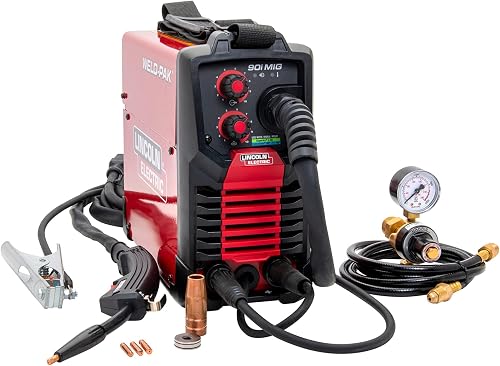
The Lincoln Electric Weld-Pak 90i MIG is a 120V inverter welder for MIG and flux-core work. It weighs 15 lb and comes with a metal case and shoulder strap for carrying.
Two knobs control wire speed and voltage. Lincoln describes it for DIY projects, hobby work and home repairs, and it includes a gun, nozzle, contact tips, work cable and clamp.
Choose it if you want a portable 120V machine for smaller jobs. The Lincoln Electric Weld-Pak 90i FC is a flux-core option if you do not need solid-wire MIG.
Lincoln Electric Weld-Pak 90i FC: Best for portable flux core
- 120V input
- Flux-core welding
- 15 lb inverter design
- Metal case and shoulder strap
This portable Lincoln Electric wire-feed machine is for flux-core welding. It uses 120V power and weighs 15 lb.
Pros
- Lightweight design
- Flux-core process
- Metal case and shoulder strap
Cons
- Not a solid-wire MIG machine
- Focused on small jobs
The Lincoln Electric Weld-Pak 90i FC is a 120V, 15 lb flux-core wire-feed welder. Its metal case and shoulder strap suit small repairs or projects where carrying the machine matters.
This model focuses on flux-core welding and has two control knobs for wire speed and voltage.
Choose it if you want portable flux-core welding on 120V power. If you need gas-shielded MIG as well, compare the Lincoln Electric Weld-Pak 90i MIG.
Hobart Handler 125: Best for simple flux-core jobs
- Flux-core wire-feed welding
- Runs on 120V input
- Welds mild steel up to 3/16 in
- 5-year limited warranty
The Handler 125 is a 120V flux-core wire-feed welder that can also run MIG with its built-in gas valve. Hobart describes it for mild steel up to 3/16 in.
Pros
- MIG capable with built-in gas valve
- Runs on 120V
- 5-year limited warranty
Cons
- 63 lb weight may limit easy moving
- Confirm the gas setup you need for MIG
The Hobart Handler 125 is a 120V flux-core wire-feed welder that can also run MIG with its built-in gas valve. Hobart describes it for mild steel up to 3/16 in.
The machine weighs 63 lb and comes with an 8 ft gun, power cord, contact tips and work cable with clamp.
Choose it if you want a Hobart wire-feed machine for flux-core work with MIG capability available. If you are comparing flux-core with gas-shielded MIG, read our MIG vs flux-core guide.
What should you check before buying a home MIG welder?
Check your power supply first, then choose between gas-shielded MIG, flux core or a machine that supports both. Process options alone do not tell you whether your home circuit is suitable.
Does your home circuit match the welder?
Match the machine’s stated input voltage and circuit needs to the power available where you plan to weld. For example, the Forney Easy Weld 140 FC calls for at least a 20A breaker, while several compact machines use 120V input.
A 120V rating by itself does not confirm that an outlet, extension cord or breaker is suitable. Follow the machine manual and have an electrician check the circuit if you are unsure.
Do you want gas-shielded MIG or flux core?
MIG setups use solid wire and shielding gas, while flux-core wire can be used without the same gas setup. The Forney Easy Weld 140 FC and Lincoln Electric Weld-Pak 90i FC are flux-core options.
For a clearer comparison of the tradeoffs, see MIG vs flux-core welding. Your material, workspace and preference for a gas setup can help decide which process suits you.
How portable does the machine need to be?
Weight gives you a quick sense of how often you may want to move a welder. The Lincoln Electric Weld-Pak 90i MIG and FC models each weigh 15 lb, while the Hobart Handler 210 MVP weighs 79 lb.
A lighter machine can be easier to carry, but portability does not replace checking the machine’s input needs or intended work. Consider where you’ll store it, where you’ll weld and what accessories you’ll carry.
Which MIG welder should you choose for home use?
Choose the Hobart Handler 210 MVP if you want 115V or 230V input and both MIG and flux-core capability. Pick the Lincoln Electric Weld-Pak 90i MIG for a portable 120V machine aimed at small jobs, or choose the Forney Easy Weld 140 FC if you want flux-core welding without gas.
Match the welder’s input requirements to your home circuit and its process to your projects. For another shortlist, see our best MIG welders under 500.
Our top 3 picks at a glance
-
1
-
2
-
3
Frequently asked questions
What is the best MIG welder for home use?
The best fit depends on your power supply and the work you plan to do. The Hobart Handler 210 MVP accepts either 115V or 230V input, while the Lincoln Electric Weld-Pak 90i MIG is a lighter 120V option for small jobs.
Check the machine’s input needs and your circuit before choosing.
Can a home MIG welder run on a regular outlet?
Some home welders use 120V input, but a household outlet alone does not confirm that your circuit is suitable. The Forney Easy Weld 140 FC calls for at least a 20A breaker.
Check the machine’s input needs and your circuit before plugging in.
Should you choose MIG or flux core for home projects?
Choose based on whether you want to use shielding gas and what kind of wire-feed process suits your work. The Forney Easy Weld 140 FC and Lincoln Electric Weld-Pak 90i FC are flux-core options.
For more on the process tradeoffs, read our MIG vs flux-core guide.
Can a home MIG welder weld aluminum?
Some machines support aluminum with the right equipment. The Hobart Handler 210 MVP is spool-gun ready, and Miller says its Millermatic 211 PRO supports aluminum with a spool gun.
See our guide to welding aluminum with a MIG welder before choosing a setup.
How do you choose a MIG welder for a home shop?
Start with input power, then match the process and portability to your work. Compare 120V models for small jobs with dual-voltage models if you may use 230V power.
Our guide to MIG welders under 500 covers another way to narrow your options.


