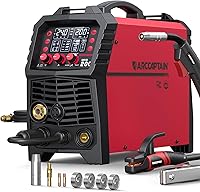
Which Welder Works for Auto Body and Thin Sheet Metal?
For most auto body and thin sheet metal work, choose a MIG welder with adjustable voltage and wire feed, then use short tacks and let the panel cool between them. A flux-core or gas MIG model can work, but control and practice matter more than extra amperage.
On this page (7 sections)
- What is the best welder for auto body and sheet metal?
- Should you use gas MIG or flux-core for thin metal?
- How do you control heat on thin sheet metal?
- What should you check before buying a sheet metal welder?
- When might TIG make sense for thin sheet?
- What safety and repair limits should you keep in mind?
- Which welder should you choose for auto body work?
For most auto body and thin sheet metal work, choose a MIG welder with adjustable voltage and wire feed, then use short tacks and let the panel cool between them. Flux-core and gas MIG machines can both be options, but careful heat control and practice matter more than buying the machine with the highest output.
A small MIG welder can suit patch panels, brackets, and other light fabrication when its settings fit the material. Start with scrap of similar thickness, because thin sheet can warp or burn through before a beginner has time to correct the weld.
What is the best welder for auto body and sheet metal?
A controllable MIG welder is the most straightforward choice for many auto body and sheet metal jobs. Wire feed makes it easier to place short welds along a seam without managing a separate filler rod.
The best welder for auto body work should have settings that let you tune voltage and wire speed to thin material. A compact machine can be easier to position around a panel, while a dual voltage model gives you more input-power options if your workspace supports them.
MIG does not make every repair simple. Panel fit, clean metal, joint access, and welding skill all affect the result, so practice on comparable scrap before touching the finished part.
For a quick overview of processes, see our guide to MIG, TIG, stick, and other welding machine types.
Should you use gas MIG or flux-core for thin metal?
Gas MIG is often easier to manage for clean, thin sheet, while flux-core can help when you want a gasless setup. The right choice depends on your work area, machine compatibility, and the wire and settings available.
Shielding gas helps protect the weld from the air, but it adds a cylinder and regulator to your setup. Flux-core wire uses its own flux and can be more practical outdoors or where wind would disturb shielding gas.
The YESWELDER 135A has gasless flux-core MIG, stick, and lift TIG modes, with an extra torch required for lift TIG. Its synergic control matches a recommended voltage to wire feed speed, and its voltage micro-adjustment is ±3V.
This machine has a 110V input and a stated mild-steel capacity up to 3/32 in. Treat that as a light-duty option, and still match the material and settings before welding.
If your main concern is the differences between gas and gasless wire, read MIG vs flux-core welding.
How do you control heat on thin sheet metal?
Use short, spaced tacks and let the panel cool between them. Long continuous beads concentrate heat in a small area and can distort thin sheet metal.
Start with the machine's recommended settings for the wire and material, then make small adjustments on matching scrap. Keep the gun angle steady and avoid lingering at the edges, where burn-through can start quickly.
Move around the seam instead of welding one long stretch. After each tack, wait until the nearby metal cools before adding another, and check that the panel remains aligned.
For more on choosing machine output and rest periods for your work, see how much duty cycle you need in a welder. A high duty cycle does not replace careful heat control on thin material.
What should you check before buying a sheet metal welder?
Check the process, input power, wire options, and control range before choosing a machine. A welder that fits your available outlet and the wire you plan to use is more useful than one selected by amperage alone.
Look at whether the machine supports gas MIG, flux-core, or both. Also check the included torch and accessories, wire sizes, and whether you need extra parts for any process you want to use.
The YESWELDER 160A supports flux-core MIG, gas MIG, stick, and lift TIG, with an extra torch required for lift TIG. It offers synergic and manual control, plus 110V and 220V input options, so it may suit a shop that wants more process flexibility.
A broader machine can be useful if you also have non-panel projects, but extra modes do not guarantee better results on thin metal. Compare its controls and setup needs with the narrower options in our guide to the best MIG welders for home use.
The Lincoln Electric Weld-Pak 90i is a 120V MIG and flux-core wire-feed machine with two knobs for wire speed and voltage. Its compact format and simple controls may suit small jobs where you want direct adjustment.
When might TIG make sense for thin sheet?
TIG can suit thin-metal work when you need fine control and have the skill to use it. It takes more coordination than MIG because you control the torch and filler separately.
The YESWELDER TIG-205P offers DC TIG, pulse TIG, and stick modes. YESWELDER describes pulse TIG as suitable for thin materials, and says the machine cannot weld aluminum.
TIG may make sense for a particular joint or finish, but it is not automatically the better auto body choice. If you are still choosing between the processes, our comparison of TIG and MIG welders explains the tradeoffs.
What safety and repair limits should you keep in mind?
Wear suitable welding protection and follow the machine manual and material guidance. Welding can expose you to intense light, heat, fumes, and fire hazards, so clear the work area and use suitable protective equipment.
This guide covers machine choice and general sheet metal work only. Vehicle panels can be part of systems where a poor repair has serious consequences, so do not use this advice for frame, brake, or safety-related repairs.
For general setup and technique questions, browse our welding help guide. If you are new to welding, practice on scrap and get qualified instruction for work where a failure could put someone at risk.
Which welder should you choose for auto body work?
Choose a MIG machine with adjustable voltage and wire feed if you want a practical starting point for thin panel work. Pick a gas MIG setup for clean indoor work when you can use shielding gas, or flux-core when a gasless setup better fits the conditions.
The YESWELDER 160A scores 8.9 and offers flux-core operation, gas MIG, and dual voltage options. The YESWELDER 135A scores 8.8 and adds synergic control for flux-core welding; the Lincoln Weld-Pak 90i scores 8.2 and keeps the controls simple.
The TIG-205P scores 8.8 for users who prefer pulse TIG and can work within its limits.
Whichever machine you choose, practice settings on matching scrap and use short, spaced welds. Then review MIG versus flux-core welders if your decision still comes down to gas or gasless wire.
Frequently asked questions
What is the best welder for auto body panels?
A MIG welder with adjustable voltage and wire feed is a practical choice for many auto body panel jobs. It is easy to learn compared with TIG, and short tacks can limit heat buildup.
Match the machine and wire to the metal, and practice on scrap of similar thickness first.
Is MIG or TIG better for thin sheet metal?
MIG is usually easier to start with for auto body and general sheet metal work. TIG gives more control over the arc and filler, but asks for more skill and setup.
Choose based on the joint, the finish you need, and the process you can control consistently.
Can a 110V welder weld auto body panels?
A 110V welder can be suitable for thin sheet metal if it offers settings that let you control heat and wire feed. Check the machine's process, wire options, and stated material range, then confirm the panel thickness and practice on matching scrap before working on the part.
How do I keep from burning through thin metal?
Use short tacks, move around the panel, and allow each area to cool before welding nearby. Set wire speed and voltage for the material, keep the fit-up tight, and practice on matching scrap.
If the metal is dirty, damaged, or too thin to hold a stable edge, stop and reassess.