Are Hobart Welders Any Good?
Yes, Hobart welders are any good for home projects: they're well regarded for solid construction and simple setup. The brand covers light flux-core repairs up to multi-voltage MIG work on thicker steel, so most home welders can find a fit.
On this page (8 sections)
- What makes Hobart welders a trusted name?
- Which Hobart welder fits a home project?
- How does the Handler 210 MVP handle different metals?
- How does the Handler 125 suit a first welder?
- What should you check before buying a Hobart welder?
- How does the Hobart helmet fit into a home setup?
- How do Hobart welders compare with other home brands?
- So, are Hobart welders any good for your project?
Yes, Hobart welders are any good for home projects: they're well regarded for solid construction and simple setup. The brand covers light flux-core repairs up to multi-voltage MIG work on thicker steel, so most home welders can find a fit.
The honest answer depends on what you're welding. A Hobart machine that suits a thin sheet metal patch won't be the same one that suits a trailer repair.
Here's how to tell whether a Hobart is right for your job.
What makes Hobart welders a trusted name?
Hobart earns its reputation on simple controls and a solid wire drive, the two things that matter most when you're learning. The brand has been building welders for decades and sells machines aimed at home shops and light commercial work.
The Handler 210 MVP uses an industrial cast aluminum wire drive. That's the part that pushes wire through the gun, and a weak drive is where cheap machines usually stumble.
A cast aluminum drive holds its alignment better and feeds wire more evenly than a stamped steel one.
Hobart also builds in protection features. The Handler 210 MVP has a built-in contactor, short circuit protection and self-resetting thermal overload protection.
In plain terms, the machine protects itself when you push it hard or when the wire shorts against the work.
Hobart backs its machines with limited warranties. The Handler 210 MVP carries a 3 year limited warranty and the Handler 125 carries a 5 year limited warranty.
That's a reasonable safety net for a home buyer.
Which Hobart welder fits a home project?
Pick the Handler 125 for light flux-core jobs and the Handler 210 MVP when you need MIG and thicker steel. The two machines sit at opposite ends of the home range.
The Handler 125 is a 120V flux-core wire feed welder. It welds up to 3/16 in mild steel and is MIG capable with a built-in gas valve.
It's the simpler machine and the easier one to start on.
The Handler 210 MVP is a multi-voltage MIG and flux-core welder. It has 210A of power and welds as thin as 24 gauge up to 3/8 inch in a single pass.
It also runs aluminum and stainless steel with the right setup.
For most home welders doing a mix of repairs, the 210 MVP is the more useful machine. It handles the thin stuff and the thicker stuff without swapping welders.
The 125 makes sense when your work stays light and your budget stays tight.
How does the Handler 210 MVP handle different metals?
The Handler 210 MVP is the flexible one in the Hobart home lineup. It's set up for MIG and flux-core welding, and Hobart lists aluminum and stainless steel among the metals it can weld.
The machine is spool gun ready. That matters for aluminum, because aluminum wire is soft and feeds poorly through a long gun liner.
A spool gun mounts a small spool right at the gun, so the wire has a short, straight path. If aluminum is on your list, read our guide to the best aluminum welders to compare spool gun options.
The Quick Select drive rolls make wire changes simpler. You pick the roll for your wire size and the machine is ready.
That's a small thing that saves time when you switch between flux-core and solid wire.
The multi-voltage plugs let you run on common 115V or 230V power without extra tools. You get more output on 230V and more portability on 115V.
A home shop with a 230V outlet gets the most from the machine.
How does the Handler 125 suit a first welder?
The Handler 125 is the simple, low-cost way into flux-core welding. It runs on standard 120V power, so a normal garage outlet is enough.
Flux-core wire carries its own shielding inside the wire. That means no gas bottle, no regulator and no hose to manage.
For a beginner welding fence posts or a trailer frame in the driveway, that's a real advantage on a windy day.
The 8 ft gun with a liner for .030 to .035 diameter wire and the weld set-up chart get you started. Hobart includes two .030 in contact tips and a work cable with clamp.
The machine weighs 63 pounds, so it's movable but not something you'll carry up a ladder.
Its limit is thickness. At 3/16 inch mild steel, it's fine for brackets, gates, carts and light repairs.
It's not the machine for heavy plate or long beads on thick stock.
What should you check before buying a Hobart welder?
Check your outlet, your metal thickness and your process first. Those three answers narrow the Hobart range quickly.
Power is the first gate. The Handler 125 needs only a 120V circuit.
The Handler 210 MVP needs either 115V or 230V, and 230V gives you its full output. If your shop lacks a 230V outlet, the smaller machine is the practical choice.
Metal thickness is the second gate. Measure the thickest steel you expect to weld.
Under 3/16 inch, the Handler 125 covers it. Above that, up to 3/8 inch in a single pass, you need the 210 MVP.
The third gate is process. If you want to weld aluminum or run solid wire with gas for cleaner beads, the 210 MVP is the one.
Flux-core only is fine for structural steel repairs where you'll grind the spatter anyway.
One more thing to check is how hard you'll run the machine. A welder's duty cycle is the share of a 10 minute period it can weld before it needs to cool.
Our guide to what duty cycle means on a welder explains how to read the rating before you buy.
How does the Hobart helmet fit into a home setup?
A welder needs a helmet, and the Hobart 770890 is the matching option for the brand. It's an auto-darkening helmet with a wide viewing area and four arc sensors.
The 9.3 inch widescreen lens gives you a broad view of the puddle and the joint. PureColor Lens technology aims to keep colors accurate so the weld and the surrounding metal look natural.
The auto-on/off control triggers the lens when you strike an arc, and continuous UV and IR protection stays on.
Four independent arc sensors handle arc detection. That matters when your head isn't square to the weld or when a hand blocks part of the lens.
The Grind mode stops the lens from darkening so you can see your work without swapping helmets.
The analog controls let you set shade, sensitivity and delay with a knob. It runs on one CR2 battery, which is included.
It accepts magnifying cheater lenses sold separately, which helps if you need extra magnification.
How do Hobart welders compare with other home brands?
Hobart sits in the solid mid-range of home welding brands, with a reputation for dependable machines and good parts support. It isn't the cheapest option and it isn't the top industrial tier either.
The Handler 210 MVP's multi-voltage design is its edge. Few home machines let you move between 115V and 230V input so easily.
That flexibility makes it a good fit for a garage that might later get a 230V outlet.
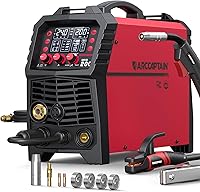
If you're comparing brands before you buy, our look at whether Everlast welders are any good covers another multi-process option. For a budget multi-process machine, see our ARCCAPTAIN MIG200 review.
The main trade-off with Hobart is price against features. You pay for the build quality and the brand's support rather than for extra modes.
If you want the most processes for the least money, a multi-process machine from another brand may fit better.
So, are Hobart welders any good for your project?
Yes, for most home welding jobs a Hobart is a sound buy. The brand's machines are built around solid wire drives, simple controls and real protection features, and the range covers both light flux-core work and multi-voltage MIG.
The decision rule is simple. Pick the Handler 125 if your work stays under 3/16 inch steel and you want the easiest 120V start with no gas bottle.
Pick the Handler 210 MVP if you need thicker steel, MIG with gas, or aluminum, and you have or plan to add a 230V outlet. Add the 770890 helmet to either setup for a wide, auto-darkening view.
Skip Hobart if you need the widest range of processes for the lowest price. In that case, compare multi-process machines first.
For everyone else doing home repairs, a Hobart will do the job it's built for.
Frequently asked questions
Is Hobart a good brand for a first welder?
Yes. Hobart's smaller machines like the Handler 125 run on standard 120V power and are set up for flux-core wire, which is a simple way to start.
The brand also publishes setup charts and a limited warranty, which helps new welders.
Can a Hobart welder weld aluminum?
The Handler 210 MVP is spool gun ready, so it can run aluminum wire with the right spool gun and gas. The Handler 125 is a flux-core machine and isn't set up for aluminum MIG work, so match the machine to the metal.
Do Hobart welders run on 120V or 240V power?
It depends on the model. The Handler 125 runs on 120V only, while the Handler 210 MVP has multi-voltage plugs for either 115V or 230V input.
Check your outlet before you choose a machine.
How thick a steel can a Hobart welder handle?
The Handler 210 MVP welds from 24 gauge up to 3/8 inch in a single pass. The Handler 125 is rated to weld up to 3/16 inch mild steel.
Thicker material takes multiple passes.