9 Best Plasma Cutter Under 500 (November 2026)
The best plasma cutters under 500 include the ARCCAPTAIN 50A Plasma Cutter for portable home-shop cutting, the ARCCAPTAIN 55A Plasma Cutter for non-touch pilot arc, and the ARCCAPTAIN iControl CUT55 Pro for app-based adjustments.
On this page (6 sections)
- How we chose these plasma cutters under 500
- The best plasma cutters under 500 by job
- What should you compare before choosing a plasma cutter?
- Which plasma cutter under 500 should you choose?
- Frequently asked questions
- Compare the clean-cut rating with your usual material thickness. Our guide to plasma cutter cut thickness explains the difference.
The ARCCAPTAIN 50A Plasma Cutter is our top pick for most home shops because it weighs 13 lb, supports 110V and 220V, and has a stated clean cut up to 1/2 in on 220V. If you need gouging and marking functions, look at the YESWELDER CUT-65DS PLUS.
The best plasma cutter under 500 for your work depends on the outlet you have, the metal thickness you cut and whether you need to work on mesh or rusty surfaces. Each cutter needs compressed air, so include a suitable compressor in your setup plan.
Our picks at a glance
-
1

-
2

-
3

- 4
 Best for non-HF startingCheck it
- 5
 Best for gouging and markingCheck it
- 6
 Check it
ARCCAPTAIN iControl CUT55 Prolux
Best for expanded-metal work - 7
 Best for three cutting modesCheck it
- 8
 Best for adjustable pilot-arc timeCheck it
- 9
 Check it
ARCCAPTAIN 55A Non-HF Plasma Cutter
Best for mesh and rust cleaning
How we chose these plasma cutters under 500
We compared the stated voltage, current range, clean-cut figures, arc-start type and controls for home-shop cutting. We also considered whether a machine includes a pressure display, air filter or modes for expanded metal and rust cleaning.
Our score weighs specs, features and buyer feedback against what you're shopping for. Cut figures vary by voltage, material and air supply, so use them as brand-stated guidance and check the operating requirements for your jobs.
Start with the outlet and material thickness you use most. The plasma cutter thickness guide explains why clean-cut and maximum-cut numbers describe different results.
| Product | Best for | Current | Voltage | Stated clean cut | Our score |
|---|---|---|---|---|---|
| ARCCAPTAIN 50A Plasma Cutter | portable home-shop cutting | 20–50A on 220V | 110V/220V | 1/2 in on 220V | 8.9 |
| ARCCAPTAIN 55A Plasma Cutter | non-touch pilot arc | 20–55A on 240V | 120V/240V | 1/2 in on 240V | 8.7 |
| ARCCAPTAIN iControl CUT55 Pro | app-based adjustments | 20–55A | 120V/240V | 8.5 | |
| YESWELDER CUT-55DS PRO | non-HF starting | 55A | 110V/220V | 8.4 | |
| YESWELDER CUT-65DS PLUS | gouging and marking | 65A | 110V/220V | 8.2 | |
| ARCCAPTAIN iControl CUT55 Prolux | expanded-metal work | 55A | 120V/240V | 8.1 | |
| ARCCAPTAIN 60A Plasma Cutter | three cutting modes | 20–60A on 220V | 110V/220V | Up to 5/8 in | 8.0 |
| SILATU 55A Plasma Cutter | adjustable pilot-arc time | 15–55A on 220V | 110V/220V | 7.9 | |
| ARCCAPTAIN 55A Non-HF Plasma Cutter | mesh and rust cleaning | 20–55A on 220V | 110V/220V | Up to 3/5 in | 7.8 |
The best plasma cutters under 500 by job
The best choice depends on what you cut most often and what your shop can power. These picks are ordered by score, from the strongest fit for general home-shop use to more specialized options.
ARCCAPTAIN 50A Plasma Cutter: Best for portable home-shop cutting
- 110V/220V dual voltage
- 13 lb weight
- Stated clean cut up to 1/2 in on 220V
- Requires compressed air
Its 13 lb stated weight and shoulder strap make it easy to move around a home shop. It supports 110V and 220V, with a current range up to 50A on 220V.
Pros
- 13 lb machine with shoulder strap
- Dual voltage
- LED display and adjustable post-flow
Cons
- Compressor sold separately
- Current tops out at 35A on 110V
The ARCCAPTAIN 50A weighs 13 lb and comes with a shoulder strap. Its LED screen shows settings such as voltage and current, with error codes if the machine cannot work.
Its current display range is 20–35A on 110V and 20–50A on 220V. ARCCAPTAIN gives recommended maximum thickness figures of 12 mm at 35A on 110V and 18 mm at 50A on 220V, plus a clean-cut figure of 1/2 in on 220V.
The built-in air filter has a quick-connect fitting, and post-flow cooling can be adjusted from 5 to 15 seconds. It requires compressed air, with the compressor sold separately.
Choose this model if you need a cutter you can carry between a garage, driveway and workbench. For more on the air setup, read our guide to choosing a compressor for a plasma cutter.
ARCCAPTAIN 55A Plasma Cutter: Best for non-touch pilot arc
- Non-touch pilot arc
- 120V/240V dual voltage
- 60% duty cycle
- Stated clean cut up to 1/2 in on 240V
The non-touch pilot arc can start without the torch head touching the workpiece. Dual voltage and 2T/4T controls suit varied cutting jobs.
Pros
- Non-touch pilot arc
- 60% duty cycle
- Air regulator and filter included
Cons
- Compressor sold separately
- Wait until the screen is off and the fan stops before switching voltage
The ARCCAPTAIN 55A uses a non-touch pilot arc that can start without the torch head touching the metal. The product description says it can cut painted and rusty surfaces.
Its stated clean cut is up to 1/2 in on 240V, with a maximum cut of 3/4 in at 55A and 240V. The machine supports 120V/240V, has a 60% duty cycle and includes an air regulator and filter.
ARCCAPTAIN recommends compressor pressure within 60 PSI and 5.3 CFM. Wait until the screen is off and the fan stops before switching voltage.
Choose it if you want a pilot arc and a stated duty cycle for repeated cutting sessions. If you are comparing it with other starting types, our plasma cutter and oxy-acetylene torch comparison covers the different roles.
ARCCAPTAIN iControl CUT55 Pro: Best for app-based adjustments
- App control up to 10 meters
- Non-touch pilot arc
- 120V/240V
- Stated quality cut up to 1/2 in
The app can adjust parameters, monitor status and save settings from up to 10 meters away. The machine also has a non-touch pilot arc and a pre-installed air regulator and filter.
Pros
- Remote app adjustments and monitoring
- Non-touch pilot arc
- Automatic post-blow timing by current range
Cons
- Compressor required
- App features may be unnecessary for straightforward cuts
The iControl CUT55 Pro adds app control for parameter changes, status monitoring and saved settings from up to 10 meters away. Its non-touch pilot arc can start without torch contact, and a pre-installed regulator and filter help with setup.
ARCCAPTAIN gives a quality-cut figure of 12 mm (1/2 in) and a maximum thickness of 20 mm (3/4 in). Its automatic post-blow time changes with the current range, so you don't need to set the timing manually.
The app can be useful if the machine sits away from your work position or you want to save settings. For basic cuts close to the machine, remote controls may add little.
YESWELDER CUT-55DS PRO: Best for non-HF starting
- Non-HF blow-back start
- 110V/220V
- IPT40 torch
- Digital display
Its blow-back start system is designed to reduce high-frequency interference. The display shows settings such as air pressure, voltage and current.
Pros
- Non-HF blow-back start
- Digital display with error codes
- 2T and 4T modes
Cons
- Compressor required
- Stated ideal clean cut is 25/64 in on 220V
The YESWELDER CUT-55DS PRO uses a non-HF blow-back start system and an IPT40 torch with a non-touch pilot arc. Its digital display shows air pressure, voltage and current.
Its stated ideal clean-cut figures are 5/16 in on 110V and 25/64 in on 220V. Maximum-cut figures are higher, but they describe a different cut goal, so use the clean-cut ratings when planning routine work.
It has 2T and 4T controls and adjustable post-flow from 5 to 20 seconds. The package includes an air compressor filter and gas hose, and a compressor is required.
Choose this model if a non-HF starting system is a priority. For a broader view of machine types, see our plain guide to welding machines.
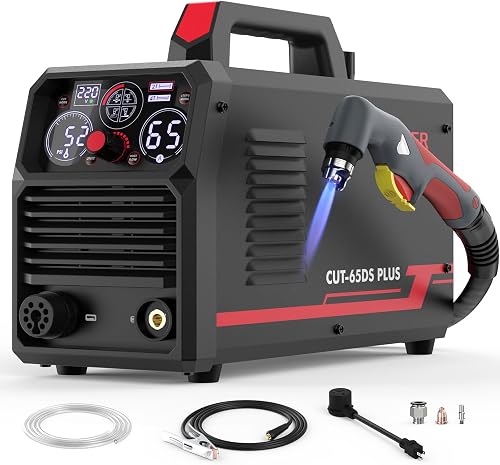
YESWELDER CUT-65DS PLUS: Best for gouging and marking
- Plate cutting, grid cutting, gouging and marking
- 110V/220V
- Non-HF blow-back start
- IPT40 torch
Four operating functions cover more than plate cutting, including gouging and marking. Its stated 220V clean-cut figure is higher than those of the other picks here.
Pros
- Gouging and marking functions
- Non-HF start
- 2-year warranty
Cons
- Compressor required
- The largest stated clean-cut capacity needs 220V
The YESWELDER CUT-65DS PLUS offers plate cutting, grid cutting, gouging and marking. Those functions can help with weld removal, surface prep or marking guide lines.
Its stated ideal clean cut is 9/16 in on 220V and 5/16 in on 110V. The stated maximum cut reaches 1 in on 220V, but the difference between ideal and maximum figures matters when you need a clean edge.
It uses a non-HF blow-back start system and has a digital display for air pressure, voltage and current. It comes with an air filter, hose and gouging consumables; a compressor is still needed.
Choose it if gouging and marking would be useful beyond plate cutting. If you are weighing a combined machine, our guide to welder and plasma cutter combos explains what to compare.
ARCCAPTAIN iControl CUT55 Prolux: Best for expanded-metal work
- App control up to 10 meters
- Expanded-metal cutting mode
- Rust removal mode
- Stated cutting range up to 22 mm on 240V
Its expanded-metal and pilot-arc rust-removal modes suit prep and cutting jobs beyond straight plate cuts. App controls include saved settings and status checks.
Pros
- Expanded-metal and rust-removal modes
- App control and monitoring
- Air-pressure display
Cons
- Compressor required
- Only the machine is specified as included
The iControl CUT55 Prolux supports expanded-metal cutting and pilot-arc rust removal, along with plate cutting. App controls let you change settings and check machine status from up to 10 meters away.
Its stated cutting range is 9–12 mm on 120V and 14–22 mm on 240V. ARCCAPTAIN recommends 0.4 MPa (57.5 PSI), and the screen monitors incoming pressure.
The package includes the plasma cutter. Confirm whether you need to source a torch, hose and other accessories separately, and arrange a compressor for the required compressed air.
ARCCAPTAIN 60A Plasma Cutter: Best for three cutting modes
- Plate, expanded-metal and rust-removal modes
- 110V/220V
- Non-touch pilot arc
- Stated clean cut up to 5/8 in
Three modes support plate work, expanded metal and rust cleaning. Its digital panel shows air pressure, current and voltage.
Pros
- Three cutting modes
- Non-touch pilot arc
- Air hose, torch and consumables included
Cons
- Compressor not included
- Maximum current is available on 220V
The ARCCAPTAIN 60A offers plate cutting, expanded-metal cutting and rust-removal modes. Its LED panel shows real-time air pressure, and error codes E80 and E81 indicate pressure that is too low or high.
ARCCAPTAIN states a clean cut up to 5/8 in and a maximum severance cut up to 15/16 in. Its current range is 20–35A on 110V and 20–60A on 220V.
The package includes an air hose, torch, earth clamp and consumables. It requires an external compressor.
SILATU 55A Plasma Cutter: Best for adjustable pilot-arc time
- Non-touch pilot arc
- 110V/220V
- Adjustable pilot-arc duration
- Digital air-pressure display
Adjustable pilot-arc duration gives you a setting for mesh or standard metal. The screen displays air pressure, voltage and current.
Pros
- Pilot-arc time adjustment
- 2T and 4T modes
- Air filter and quick connector
Cons
- Compressor sold separately
- Recommended air pressure is 70 PSI
The SILATU 55A has an adjustable pilot-arc duration, with longer settings for mesh and shorter settings for standard metal. Its digital screen shows air pressure, voltage and current.
The stated maximum thickness is 1/2 in at 40A on 110V and 2/3 in at 55A on 220V. SILATU recommends 70 PSI and an air flow of 250 liters per minute, so check that your compressor can supply those conditions.
The machine has 2T and 4T controls and adjustable post-time. Its stated weight is 12.57 lb, and it requires a separate compressor.
ARCCAPTAIN 55A Non-HF Plasma Cutter: Best for mesh and rust cleaning
- Blow-back non-HF start
- Mesh cutting and rust-cleaning modes
- 110V/220V
- Air-pressure monitoring
Its non-HF blow-back start pairs with mesh cutting and rust-cleaning modes. Air-pressure monitoring and 2T/4T controls add operating guidance.
Pros
- Non-HF blow-back start
- Mesh and rust-cleaning modes
- Pressure warnings
Cons
- Compressor required
- Included accessories are not specified
The ARCCAPTAIN 55A Non-HF Plasma Cutter combines a non-HF blow-back start with mesh-cutting and rust-cleaning modes. Its air-pressure system displays readings and gives an E80 warning below 30 PSI or an E81 warning above 80 PSI.
It supports 110V and 220V, with a current range of 20–35A on 110V and 20–55A on 220V. ARCCAPTAIN states a clean cut up to 3/5 in and a maximum thickness of 26 mm on 220V.
The IPT60 torch has adjustable pilot-arc time from 2 to 10 seconds and post-flow from 5 to 15 seconds, plus 2T/4T operation. It requires an external compressor; accessory details are not specified in the product data.
What should you compare before choosing a plasma cutter?
Compare input power, clean-cut thickness, compressor needs and arc-start type before choosing a plasma cutter. A larger maximum-cut number alone does not tell you how cleanly it will handle your regular material.
Does a plasma cutter under 500 need a compressor?
Yes, these cutters need compressed air, and most require a separate compressor. Match pressure and air flow to each cutter's recommendations, then check the hose and connector requirements.
A machine with a built-in filter or regulator still needs an air source. See our plasma cutter compressor guide before selecting one.
Should you choose 110V or 220V?
Choose based on the outlet available and the thickness you need to cut. Dual-voltage cutters generally provide a higher current range and thicker stated cuts on 220V than on 110V.
Read the voltage-specific cut figures carefully. Don't assume the same performance from both inputs, and follow the machine's voltage-switching instructions.
What does pilot arc help you cut?
A non-touch pilot arc starts without the torch tip touching the metal, which can help on painted, rusty or uneven surfaces. For mesh and expanded metal, look for a model that names those materials or provides a dedicated mode.
Pilot arc does not replace choosing the right air pressure, current and cutting speed for your material.
How thick can an under-500 plasma cutter cut cleanly?
Use the stated clean-cut or ideal clean-cut figure for routine work, not the maximum-cut or severance number. Maximum figures describe a different goal and may not give the edge quality you want.
Our guide to plasma cutter thickness ratings explains how to compare those numbers.
Which plasma cutter under 500 should you choose?
Choose the ARCCAPTAIN 50A if portability and dual-voltage cutting matter most. Pick the YESWELDER CUT-65DS PLUS if you need gouging and marking, or the ARCCAPTAIN 60A for plate, mesh and rust-cleaning modes.
Match the machine to your outlet and compressor. If you also need a welder, compare options in our welder and plasma cutter combo guide.
Frequently asked questions
Can you get a good plasma cutter under 500?
Yes. Several options in this roundup offer dual voltage, pilot-arc features and digital controls.
The right fit depends on your input power, cut thickness and work type.
Check the stated clean-cut capacity for the voltage you can use, and plan for a separate air compressor where required.
What should I check before buying a plasma cutter?
Start with the power source available in your shop, then compare the cutter's stated cut capacity at that voltage. Also check whether it needs an external compressor and whether its arc start suits your work.
For repeated cuts, duty cycle and torch controls can affect how comfortably you work.
Do plasma cutters under 500 need an air compressor?
These picks need compressed air, and several specify that the compressor is sold separately. Match compressor pressure and air-flow capacity to the cutter's requirements before you buy.
Our guide to air compressors for plasma cutters covers connection and sizing questions.
Is 110V or 220V better for a plasma cutter?
220V supports the higher current ranges and thicker stated cuts on many dual-voltage machines here. A 110V outlet can suit lighter work, but each machine has a lower current limit at that input.
Check the cut figures for your material and voltage before choosing.
How thick can a budget plasma cutter cut?
It depends on the machine, voltage, material and whether you mean a clean cut or a maximum severance cut. Those figures are not interchangeable.
Compare the clean-cut rating with your usual material thickness. Our guide to plasma cutter cut thickness explains the difference.
Our top 3 picks at a glance
-
1
-
2
-
3
Frequently asked questions
Can you get a good plasma cutter under 500?
Yes. Several options in this roundup offer dual voltage, pilot-arc features and digital controls.
The right fit depends on your input power, cut thickness and work type.
Check the stated clean-cut capacity for the voltage you can use, and plan for a separate air compressor where required.
What should I check before buying a plasma cutter?
Start with the power source available in your shop, then compare the cutter's stated cut capacity at that voltage. Also check whether it needs an external compressor and whether its arc start suits your work.
For repeated cuts, duty cycle and torch controls can affect how comfortably you work.
Do plasma cutters under 500 need an air compressor?
These picks need compressed air, and several specify that the compressor is sold separately. Match the compressor's pressure and air-flow capacity to the cutter's requirements before you buy.
Our guide to air compressors for plasma cutters covers the connection and sizing questions.
Is 110V or 220V better for a plasma cutter?
220V supports the higher current ranges and thicker stated cuts on many dual-voltage machines here. A 110V outlet can suit lighter work, but each machine has a lower current limit at that input.
Check the cut figures for your material and voltage before choosing.
How thick can a budget plasma cutter cut?
It depends on the machine, voltage, material and whether you mean a clean cut or a maximum severance cut. Those figures are not interchangeable.
Compare the clean-cut rating with your usual material thickness.
Our guide to plasma cutter cut thickness explains the difference.