8 Best TIG Welders for Beginners (October 2026)
The best beginner TIG welders include the YESWELDER TIG-205P for pulse TIG learners, the ARCCAPTAIN TIG 205P Pro for app-guided practice, and the ARCCAPTAIN TIG 205 Pro for cold TIG modes.
On this page (10 sections)
- How we chose beginner TIG welders
- Compare the best TIG welders for beginners
- The best TIG welders for beginners by use
- How should you choose a TIG welder as a beginner?
- Is pulse TIG useful for learning?
- Can you TIG weld aluminum as a beginner?
- How should you set up and care for a beginner TIG welder?
- What common beginner TIG mistakes should you avoid?
- What else should you plan for before your first weld?
- Which beginner TIG welder should you choose?
The best TIG welder for beginners is the YESWELDER TIG-205P if you want DC TIG, pulse TIG and stick modes in one auto-sensing dual-voltage machine. If aluminum is on your project list, choose the Lincoln Electric Square Wave 205 because it is the AC/DC option here.
TIG welding rewards steady movement and careful setup. Your first machine should fit the metals you plan to join, your available power, and how many controls you want to learn.
For a plain overview of process choices, read our guide to MIG, TIG, stick and other welding machine types. If TIG versus MIG is still an open question, compare what changes between TIG and MIG welding.
Our picks at a glance
-
1

-
2
-
3

- 4
 Check it
ARCCAPTAIN DC 5-in-1 TIG Welder
Best for mobile hobby welders - 5
 Best for repeatable spot workCheck it
- 6
 Best for simple garage practiceCheck it
- 7
 Check it
ARCCAPTAIN 200A Stick and Lift TIG
Best for stick-first beginners - 8
 Check it
Lincoln Electric Square Wave 205
Best for aluminum projects
How we chose beginner TIG welders
We compared process options, input power, controls and included equipment against the needs of a new TIG welder. We focused on what each setup lets a beginner practice, where its limits are, and how much process choice it adds.
A beginner may value clear controls and a useful starting process, but there is no single best setup for every project. Aluminum requires AC TIG, while most of these listed machines use DC output.
Compare the best TIG welders for beginners
The main differences are aluminum support, process range and how much control each machine offers. Use the comparison to narrow your choices, then check the individual notes for fit.
| Product | Best for | Processes | Input | Aluminum | Our score |
|---|---|---|---|---|---|
| YESWELDER TIG-205P | pulse TIG learners | Stick, DC TIG, pulse TIG | 110V/220V, auto-sensing | Not suitable | 8.8 |
| ARCCAPTAIN TIG 205P Pro | app-guided practice | DC TIG, pulse TIG, lift TIG, spot TIG, MMA | 120V/240V | Not suitable | 8.5 |
| ARCCAPTAIN TIG 205 Pro | cold TIG modes | Cold TIG, 4T DC TIG, cold spot TIG, 2T DC TIG, stick | 120V/240V | Not suitable | 8.2 |
| ARCCAPTAIN DC 5-in-1 TIG Welder | mobile hobby welders | Lift, HF, pulse and spot TIG, stick | 110V/220V | 8.1 | |
| TOOLIOM 200A Pulse TIG Welder | repeatable spot work | Stick, DC TIG, pulse TIG, TIG spot | 110V/220V, automatic sensing | 8.0 | |
| S7 200A TIG and Stick Welder | simple garage practice | DC TIG, stick | 110V/220V | 7.6 | |
| ARCCAPTAIN 200A Stick and Lift TIG | stick-first beginners | Stick, lift TIG | 110V/220V | 7.9 | |
| Lincoln Electric Square Wave 205 | aluminum projects | AC/DC TIG, stick | 120V or 230V | 8.7 |
The best TIG welders for beginners by use
The right pick depends on the metal and the controls you want to learn first. These machines range from a focused TIG and stick setup to models with several TIG modes.
YESWELDER TIG-205P: Best for pulse TIG learners
- Stick, DC TIG and pulse TIG
- Automatic 110V/220V input sensing
- HF non-touch arc start
- 5-pin foot pedal interface
Three processes and auto-sensing dual voltage give a beginner room to learn TIG and use stick mode. It is a DC machine and cannot weld aluminum.
Pros
- Pulse controls include frequency, duty cycle and current
- HF non-touch arc starting
- Auto Memory saves settings
Cons
- Cannot weld aluminum
- Foot pedal sold separately
The YESWELDER TIG-205P is the best fit for a beginner who wants pulse TIG without giving up stick mode. It combines stick, DC TIG and pulse TIG, and its input automatically senses 110V or 220V.
HF non-touch arc starting lets you start TIG without touching the tungsten to the work. The large LED display shows welding parameters, while Auto Memory saves settings after power-off.
Pulse controls include frequency, duty cycle and current. The machine also has a 5-pin foot pedal interface, but the foot pedal itself is not included.
This is a DC machine, so it cannot weld aluminum. Choose it for steel practice and varied DIY jobs, and look to an AC/DC option if aluminum matters.
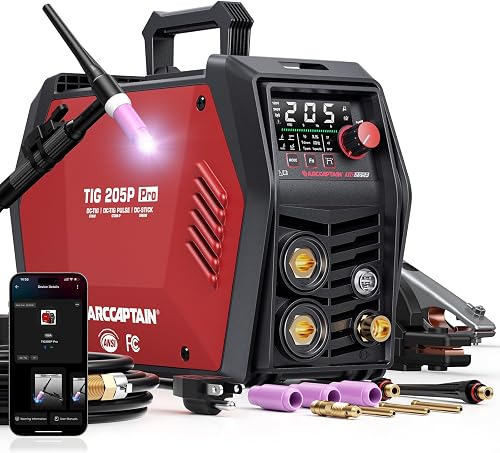
ARCCAPTAIN TIG 205P Pro: Best for app-guided practice
- DC TIG, pulse TIG, lift TIG, spot TIG and MMA
- 120V/240V input
- App control
- 3-year warranty
App controls support mode selection, parameter changes and preset recall. Its DC-only output suits steel and other listed metals, but not aluminum.
Pros
- Five welding modes
- Adjustable pulse and TIG settings
- App offers status monitoring and error code analysis
Cons
- Cannot weld aluminum
- Foot pedal sold separately
The ARCCAPTAIN TIG 205P Pro suits beginners who want several TIG modes and phone-based settings access. Its five modes are DC TIG, pulse TIG, lift TIG, spot TIG and MMA stick.
The ARCCAPTAIN app can monitor welder status, change modes and parameters, recall presets, and show error code analysis and FAQs. That can make settings easier to review, though learning the panel controls still matters.
It accepts 120V or 240V input and supports an optional 5-pin foot pedal for hands-free current control. The output is DC only, so it is not suitable for aluminum.
Choose this when app control and multiple TIG methods matter more than a basic interface. ARCCAPTAIN provides a 3-year warranty.
ARCCAPTAIN TIG 205 Pro: Best for cold TIG modes
- Cold TIG, 4T DC TIG, cold spot TIG, 2T DC TIG and stick
- 120V/240V input
- App control
- 3-year warranty
App monitoring and several TIG modes suit a beginner who wants to adjust settings from a phone. The DC-only output is intended for steel, stainless steel and chrome-moly steel.
Pros
- App supports parameter changes and FAQs
- Includes TIG torch and stick leads
- Compatible foot pedal option
Cons
- Cannot weld aluminum
- Foot pedal is not included
The ARCCAPTAIN TIG 205 Pro is a steel-focused option for buyers who want app access and cold TIG modes. It combines cold TIG, 4T DC TIG, cold spot TIG, 2T DC TIG and stick.
Its app supports process selection, parameter changes, welder monitoring and error code analysis. The large LED display also shows settings at the machine, so you can use the controls without relying on your phone.
The machine accepts 120V or 240V input and is compatible with an ARCCAPTAIN 5-pin foot pedal, sold separately. It runs DC output only and does not support aluminum welding.
Choose it if you expect to use the cold TIG or spot options on steel projects. For simpler pulse practice, compare the TIG-205P and TIG 205P Pro above.
ARCCAPTAIN DC 5-in-1 TIG Welder: Best for mobile hobby welders
- Lift, HF, pulse and spot TIG plus stick
- 110V/220V input
- 10.25 lb stated weight
- 2-year quality guarantee
Its five DC processes cover several ways to practice TIG and stick, and ARCCAPTAIN gives a 10.25 lb weight. It does not offer AC output for aluminum.
Pros
- Pulse and spot TIG modes
- Adjustable TIG parameters
- Shoulder strap and carrying handle
Cons
- DC output only
- Foot pedal support is limited to 2T TIG modes
The ARCCAPTAIN DC 5-in-1 makes sense if you want several DC TIG methods in a lighter package. It offers lift, HF, pulse and spot TIG, plus stick mode.
ARCCAPTAIN gives a weight of 10.25 lb and includes a carrying handle and shoulder strap. The display shows real-time data, and the TIG controls include pulse frequency, start current, base current, peak current, post gas, down-slope and end current.
It supports 110V and 220V input. Foot pedal control is supported in 2T TIG modes, and the output is DC only, so this model does not weld aluminum.
Choose it if transport and process variety matter more than AC output. ARCCAPTAIN backs it with a 2-year quality guarantee.
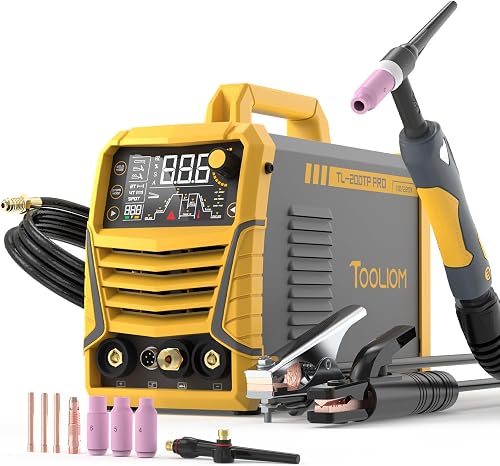
TOOLIOM 200A Pulse TIG Welder: Best for repeatable spot work
- Stick, DC TIG, pulse TIG and TIG spot
- Automatic 110V/220V sensing
- 5-pin foot pedal interface
- Thermal protection
TIG spot mode helps repeat short welds, while pulse settings and stick mode add useful practice options. TOOLIOM describes use on stainless, alloy steel, iron and other non-ferrous metals.
Pros
- Four modes in one machine
- HF ignition in DC TIG mode
- Digital display shows mode and parameters
Cons
- Input voltage range is not specified
- Weight is not specified
The TOOLIOM 200A is a fit for beginners who want repeatable TIG spot welds alongside pulse and stick modes. Its four processes are stick, DC TIG, pulse TIG and TIG spot.
Automatic sensing adapts to 110V or 220V power sources. A digital display shows amperage, mode and parameters, while the reserved 5-pin interface supports a compatible foot pedal for arc on/off and current adjustment.
TOOLIOM describes the machine for stainless steel, alloy steel, iron and other non-ferrous metal welding. Its suitability for aluminum is not specified, so choose it for the listed metal types and confirm compatibility before planning aluminum work.
The thermal protection system shuts the unit down if it overheats or current overload occurs. Choose it if you expect to practice short, repeatable spot welds.
S7 200A TIG and Stick Welder: Best for simple garage practice
- DC TIG and stick
- 110V/220V input
- Digital current display
- TIG torch and leads included
Simple controls and a current display keep the process choices focused for garage projects. It includes a TIG torch, ground clamp, electrode holder and accessories.
Pros
- Dual voltage input
- Two familiar welding processes
- Common TIG consumables compatibility
Cons
- No pulse mode
- Foot pedal support is not specified
The S7 200A is a straightforward choice if you want to learn DC TIG and stick without pulse settings. Simple controls and a digital current display keep the setup focused on the two processes.
It accepts 110V or 220V input and includes a TIG torch, ground clamp, electrode holder and accessories. S7 says it works with common TIG consumables such as tungsten electrodes, ceramic cups and collets.
The machine is described for garage repairs, stainless steel, mild steel and light fabrication. Its product facts do not specify a foot pedal interface or pulse function, so choose another pick if either feature is a must.
This option suits a home workshop where the priority is a basic dual-voltage TIG and stick machine. Read our guide to the best stick welders for home shops if stick welding may be your main process.
ARCCAPTAIN 200A Stick and Lift TIG: Best for stick-first beginners
- Stick and lift TIG
- 110V/220V input
- Synergic control
- TIG torch included
This is primarily a stick welder with lift TIG added, so it fits a beginner who wants both processes in a compact unit. Synergic control matches current and voltage after rod diameter selection in stick mode.
Pros
- Lift TIG torch included
- Adjustable hot start and arc force
- Handle and shoulder strap included
Cons
- No pulse TIG mode
- TIG controls are less detailed than the other picks
The ARCCAPTAIN 200A Stick and Lift TIG is best for someone who expects to use stick often and wants lift TIG available for smaller jobs. It combines MMA stick and lift TIG, with a torch included.
For stick welding, synergic control matches current and voltage after you select the electrode diameter. Hot start and arc force are adjustable, and anti-stick helps reduce electrode sticking.
ARCCAPTAIN gives a weight of 7.2 lb and includes a handle and shoulder strap. It accepts 110V or 220V input, but it does not offer pulse TIG or the broader TIG controls found on the other picks.
Choose it as a stick-first machine with a TIG option. For more TIG-focused controls, compare the S7 or the pulse machines above.
Lincoln Electric Square Wave 205: Best for aluminum projects
- AC/DC TIG
- Stick welding capability
- 120V or 230V input
- Foot Amptrol included
The Square Wave 205 is the only listed AC/DC pick, making it the option for a beginner whose plans include aluminum. Its package includes a TIG torch, foot control, gas regulator and stick holder.
Pros
- AC frequency and balance controls for aluminum
- TIG and stick from one power source
- 120V and 230V adapters included
Cons
- Heavier than the compact DC picks
- Product facts give fewer detailed control specs
The Lincoln Electric Square Wave 205 is the choice here for a beginner who plans to weld aluminum as well as steel. Its AC/DC TIG capability includes AC frequency and balance controls, while stick welding is also available.
The machine can use a standard 120V circuit or 230V for maximum output. The package includes a TIG torch, foot control, gas regulator and hose, stick electrode holder, ground clamp and adapters.
At a stated 36 lb, it is heavier than the compact DC machines in this roundup. Compare the manual and included setup with your planned work before buying.
Choose it when AC output is essential. For help comparing the processes, see TIG versus stick welding and what changes.
How should you choose a TIG welder as a beginner?
Start with the metal you plan to weld. For steel, DC TIG covers the needs of many garage and DIY projects; for aluminum, choose an AC/DC model such as the Lincoln Electric Square Wave 205.
Next, check the power available where you will weld. Several picks accept two input voltages, but that does not mean every outlet can provide maximum output.
Match the machine's input requirements to the circuit and plug you have, and consult its instructions before connecting it.
Choose a starting method you can learn comfortably. HF start begins the arc without touching the tungsten to the work, while lift TIG starts with contact followed by a lift.
A machine with more start methods gives options, but those options also mean more controls to understand.
Decide whether you need stick welding in the same machine. Stick can be useful for outdoor repairs and heavier work, while a simpler TIG-focused setup may be easier to learn if you mainly want clean, controlled welds on steel.
A foot pedal can let you adjust current as you weld. Check whether the machine has an interface, whether the pedal is compatible, and whether the pedal works in the mode you plan to use.
Some picks require a separate pedal or limit control to certain modes.
Finally, look at what is included. A torch and leads do not necessarily cover every item needed for TIG work.
Plan for shielding gas equipment, tungsten, filler material, a work clamp, protective gear and suitable practice stock.
Is pulse TIG useful for learning?
Pulse TIG can help you practice controlling heat input, especially on thinner material, but it adds settings to learn. The YESWELDER, ARCCAPTAIN TIG 205P Pro, TOOLIOM and ARCCAPTAIN DC 5-in-1 include pulse modes.
A beginner who likes adjusting settings can start with pulse. If you would rather focus on torch angle, arc length, filler timing and steady travel, the S7's two-process setup keeps the choices simpler.
Use the manual to understand what each pulse setting changes. Begin with one adjustment at a time and keep a note of settings that produce a stable arc on your practice material.
Can you TIG weld aluminum as a beginner?
Yes, a beginner can weld aluminum with TIG if the machine provides AC output and the rest of the setup is suitable. In this group, the Lincoln Electric Square Wave 205 is the AC/DC option, with AC frequency and balance controls.
The DC-only machines are not suitable for aluminum. TOOLIOM's described use includes other non-ferrous metals, but its aluminum suitability is not specified, so don't assume that means it can weld aluminum.
If you expect to work on aluminum regularly, give AC/DC capability priority over extra DC modes or app control. Read our guide to the best aluminum welders for more help comparing machines for that metal.
How should you set up and care for a beginner TIG welder?
Set the machine up on a stable, dry work surface with enough room around it for airflow. Keep the work area clear of flammable material, and follow the manual for grounding, input power, gas connections and any cooling requirements.
Prepare clean metal before striking an arc. Remove paint, oil, rust and dirt from the joint area, then clamp the work securely so it cannot shift.
Good preparation makes it easier to see whether a weld issue comes from technique or from contamination.
Inspect the torch, cables, gas connections and work clamp before use. Replace damaged consumables and check that the tungsten is prepared for the job.
Keep the torch and electrical connections dry, and don't handle hot parts without suitable protection.
After welding, let the machine cool as its instructions require and keep its vents clear of dust. Store the torch, leads and consumables so they stay protected from impact and moisture.
What common beginner TIG mistakes should you avoid?
The most common early mistakes are rushing travel speed, holding an inconsistent arc length, using dirty material and trying to change too many settings at once. Practice on scrap of the same material and thickness as the planned project before welding anything important.
Keep the tungsten from touching the puddle or filler. If it becomes contaminated, stop and prepare it again rather than continuing with a compromised electrode.
Use a steady torch position and feed filler in a consistent rhythm.
Don't assume a higher amperage setting is always better. Follow the machine's guidance for your material and thickness, and make small adjustments while observing the bead and puddle.
Protect yourself from arc flash, sparks, hot metal and fumes with suitable gear and ventilation. Clear the area of combustible items, keep a fire extinguisher nearby, and never weld a sealed container.
What else should you plan for before your first weld?
Plan for the full setup, not only the power source. TIG work also depends on a torch, shielding gas equipment, tungsten and filler materials, a work clamp, protective gear and a suitable practice surface.
Check which parts are included and what the machine needs for your intended process. Our guide to what to buy to start welding at home covers starter equipment, while our plain guide to welding machine types can help compare process options.
Which beginner TIG welder should you choose?
Choose the YESWELDER TIG-205P for pulse TIG, stick mode and auto-sensing input on steel projects. Choose the Lincoln Electric Square Wave 205 if aluminum is part of the plan, or the S7 if you want a simpler TIG and stick setup.
Pick an ARCCAPTAIN model if app control, cold TIG modes or a lighter carry machine best match your work. The TOOLIOM suits repeatable spot practice, while the stick-first ARCCAPTAIN is for buyers who expect stick welding to be their main process.
The best TIG welder for beginners is the one that fits your metal, power supply and learning style. If you're still weighing processes, read our TIG vs MIG comparison before choosing a machine.
Our top 3 picks at a glance
-
1
-
2
-
3
Frequently asked questions
What is the best TIG welder for a beginner?
For steel practice and mixed home projects, the YESWELDER TIG-205P combines DC TIG, pulse TIG and stick mode with automatic 110V/220V sensing.
Choose an AC/DC machine if aluminum is part of your plan, since DC-only TIG welders here are not suitable for that work.
Can a beginner TIG welder weld aluminum?
Yes, if it has AC TIG output. The Lincoln Electric Square Wave 205 is the AC/DC model in this group, with AC frequency and balance controls.
The other TIG picks are DC output models, so they are not suitable for aluminum welding.
Should a beginner choose pulse TIG?
Pulse TIG gives you control over pulse frequency, duty cycle and current on models that include it. That adds settings to learn, but can help when working with thin material.
If you want fewer controls at first, a DC TIG and stick machine such as the S7 keeps the process choices simpler.
Is lift TIG easier to start with than HF TIG?
Lift TIG starts when the tungsten touches the work and lifts away; HF TIG starts without touching the work. The listed machines differ in which starting methods they offer.
Choose based on the start method you want to practice and follow the machine's instructions.


