8 Best Stick Welders for Home Shops (October 2026)
The best stick welders for home shops include the ARCCAPTAIN 200A Stick Welder for portable home-shop work, the YESWELDER 205A Stick Welder for adjustable arc settings, and the Lincoln Electric Weld-Pak 225i for a wider output range.
On this page (5 sections)
The ARCCAPTAIN 200A Stick Welder is the best stick welder for most home shops that want an easy-to-carry dual-voltage machine with automatic current matching. Choose the YESWELDER for adjustable arc controls, Lincoln Electric for its stated 10–225A range, or TOOLIOM's mini model if your only outlet is 110V.
Stick welding is a practical choice for repairs and fabrication when you want an arc process that uses coated electrodes rather than shielding gas. Your choice still needs to fit your outlet, work, electrodes and plans for carrying or storing the welder.
For a quick overview of process differences, see our plain guide to welding machine types. If you're deciding between processes for home projects, compare stick welding with flux core and MIG with stick welding.
Our picks at a glance
-
1

-
2

-
3

How we chose these stick welders
These picks address different home-shop needs, including outlet options, output, portability, controls and included accessories. We compared the stated features and accessories, then ordered the machines by how well those details fit common home-shop jobs.
The scores reflect each machine's stated features and fit for this roundup's readers. The right choice depends on your outlet and work, so a machine with a higher maximum current won't automatically be the best fit for every shop.
Input voltage affects available output. The ARCCAPTAIN 205A, for example, is stated to provide up to 150A on 120V and up to 205A on 240V, so compare the current range for the supply you actually plan to use.
| Product | Best for | Input | Output | Modes | Our score |
|---|---|---|---|---|---|
| ARCCAPTAIN 200A Stick Welder | portable home-shop work | 110V/220V | Up to 200A | Stick and lift TIG | 8.9 |
| YESWELDER 205A Stick Welder | adjustable arc settings | 110V/220V | Up to 205A | Stick and lift TIG | 8.7 |
| Lincoln Electric Weld-Pak 225i | a wider output range | 120V/230V | 10–225A | 8.6 | |
| DEKOPRO 160A Stick Welder | a lower-output option | 110V/220V | 160A model | MMA stick | 8.3 |
| ARCCAPTAIN 205A Stick Welder | app-based adjustments | 120V/240V | 20–150A on 120V; 20–205A on 240V | Stick and lift TIG | 8.1 |
| ARCCAPTAIN 220A Stick Welder | added controls and accessories | 110V/220V | 20–220A | Stick and lift TIG | 8.0 |
| TOOLIOM 195A Stick Welder | a lift TIG starter set | 110V/220V | Up to 195A | 7.7 | |
| TOOLIOM 135A Mini Stick Welder | 110V-only portability | 110V only | 135A model | Stick and lift TIG | 7.5 |
The best stick welders for home shops
The ARCCAPTAIN 200A is the best fit here for a portable, dual-voltage home-shop machine with automatic current matching. The YESWELDER 205A suits buyers who want adjustable Hot Start and Arc Force, while Lincoln Electric's Weld-Pak 225i offers the broadest stated output range in this group.
ARCCAPTAIN 200A Stick Welder: Best for portable home-shop work
- 110V/220V input
- 7.2 lb stated weight
- Stick and lift TIG modes
- Synergic current matching
A lightweight dual-voltage machine with automatic current matching after you select rod diameter. It also offers lift TIG mode, though a torch is not included.
Pros
- Lightweight 7.2 lb body
- Dual-voltage input
- Automatic current matching
Cons
- Lift TIG torch not included
- Requires waiting for the screen and fan to stop before powering on
The ARCCAPTAIN 200A is a good choice if you move your welder between a garage, driveway or storage shelf. It has a handle and shoulder strap, and its stated weight is 7.2 lb.
Select an electrode diameter and synergic control automatically matches current and voltage. You can then adjust current yourself, and the LED screen makes settings easier to read while wearing a helmet.
The machine supports 6010, 6011, 6013 and 7018 rods, with stick and lift TIG modes. A lift TIG torch is not included, so factor that into your plans if TIG is a reason for choosing it.
Follow its power-up instruction: wait until the screen turns off and the fan stops before powering on. Choose this machine for everyday portability and guided setup, and skip it if you need a torch in the box for TIG work.
YESWELDER 205A Stick Welder: Best for adjustable arc settings
- 110V/220V input
- Up to 205A
- Hot Start and Arc Force adjustable from 1–10
- LED display
The dual-voltage machine pairs an LED display with adjustable Hot Start and Arc Force settings. It supports stick and lift TIG welding.
Pros
- Adjustable Hot Start and Arc Force
- LED display
- Dual-voltage input
Cons
- Heavier than some compact options
- Lift TIG torch not included
The YESWELDER 205A is a strong choice if you want more control over how the arc starts and responds. Hot Start and Arc Force each have 10 adjustment levels, and a precision knob controls settings on its LED display.
It accepts 110V or 220V input and supports up to 205A. The machine works with 6010, 6011, 6013 and 7018 electrodes, and also supports lift TIG.
Pick it if adjustable arc behavior matters more to you than the lightest possible setup. Skip it if you're looking for a lift TIG torch included with the machine, since that accessory isn't included.
Lincoln Electric Weld-Pak 225i: Best for a wider output range
- 120V/230V input
- 10–225A output range
- Stick and touch start TIG
- 30% duty cycle at 225A on 230V
The broad stated output range and dual-voltage input suit home shops that want a higher-output option. Touch Start TIG is supported with additional accessories.
Pros
- 10–225A output range
- Dual-voltage input
- Includes work and electrode cables
Cons
- Heavier than the compact picks
- TIG accessories required for TIG use
Lincoln Electric's Weld-Pak 225i is the pick for a home shop that needs a broad stated current range and wants the included cables and clamps. It supports 120V/230V input and has a stated output range of 10–225A.
Lincoln Electric says it can weld 12-gauge sheet metal through 5/16 in steel in a single pass. Its stated duty cycle is 30% at 225A on 230V input, so check the guide to welder duty cycle to understand how a rating relates to your work pace.
The package includes a shoulder strap, work cable and clamp, electrode cable and holder, plus an input cable and adapters. Touch Start TIG is supported, but you need additional TIG accessories for that process.
Choose it if you value output range and a supplied cable kit. At a stated 20 lb, it's heavier than the compact picks, so skip it if low carry weight is your main requirement.
DEKOPRO 160A Stick Welder: Best for a lower-output option

- 110V/220V input
- 160A model
- Digital display
- Hot Start and anti-stick
A dual-voltage 160A option with a carrying handle, digital display, Hot Start and anti-stick features. It is described for mild steel, weld steel, stainless steel and cast iron.
Pros
- Dual-voltage input
- Digital display
- Carrying handle
Cons
- No lift TIG mode stated
- Output is lower than most picks here
The DEKOPRO 160A suits a home shop that needs a straightforward stick machine with a digital display and lower stated maximum output than most picks here. Hot Start, anti-stick and arc stability functions help with starting and maintaining the arc.
It supports 110V/220V input and is described for mild steel, weld steel, stainless steel and cast iron. DEKOPRO also mentions aluminum, but the available details don't specify a process setup or material limits, so confirm the right equipment and procedure before planning aluminum work.
Choose it for general projects that fit a 160A model and don't require lift TIG. Skip it if you need that second process or expect your work to call for a higher output range.
ARCCAPTAIN 205A Stick Welder: Best for app-based adjustments

- 120V/240V input
- Up to 205A on 240V
- Phone app connection
- 120V output up to 150A
This dual-voltage model adds app connection and automatic current matching after you select an electrode diameter or workpiece thickness. Its stated output depends on input voltage.
Pros
- Phone app connection
- 8.2 lb stated weight
- Lift TIG mode
Cons
- Lift TIG torch not included
- Current is limited to 150A on 120V
The ARCCAPTAIN 205A suits a home shop where phone-based parameter adjustment and status monitoring would be useful. Its app supports adjustments and monitoring within a stated 10 m range.
The current range depends on the power supply: 20–150A on 120V and 20–205A on 240V. Select an electrode diameter or workpiece thickness for automatic matching, then adjust the current as needed.
It supports stick and lift TIG, with the torch sold separately. A shoulder strap and dust cover are included, and the stated weight is 8.2 lb.
Choose this model if you want app controls and can match your outlet to the current range your work requires. Skip it if you need its 205A maximum but only have a 120V supply; that input is limited to 150A.
ARCCAPTAIN 220A Stick Welder: Best for added controls and accessories

- 110V/220V input
- Up to 220A
- Adjustable Hot Start and Arc Force
- Includes 10 rods
This dual-voltage option adds adjustable plate thickness, Hot Start and Arc Force settings. The included kit lists welding rods, a shoulder strap and a 110/220V adapter.
Pros
- Large LED screen
- Adjustable settings
- Includes welding rods
Cons
- Lift TIG torch sold separately
- Heavier than the lightest picks
The ARCCAPTAIN 220A is a good fit if you want adjustable settings and welding rods included. Its 3.2 in LED screen displays parameters, while synergic control matches current and voltage after you select the rod diameter.
You can adjust settings for plate thickness, Hot Start and Arc Force. The stated current range is 20–220A, and it supports stick and lift TIG, though a torch is sold separately.
The package includes 10 rods, a wire brush, a shoulder strap, a 110/220V power adapter, and 10 ft electrode and ground leads. Its stated weight is 9.5 lb.
Choose it if the adjustable controls and starter accessories suit your work. Skip it if you want a lift TIG torch included, and wait for the screen and fan to stop before powering on again.
TOOLIOM 195A Stick Welder: Best for a lift TIG starter set

- 110V/220V input
- Up to 195A
- Lift TIG torch included
- Includes gloves and E6013 rods
This stick and lift TIG machine includes a torch, gloves and E6013 rods. It supports E6010, E6013 and E7018 electrodes.
Pros
- Lift TIG torch included
- Includes gloves and rods
- Adjustable Hot Start and Arc Force
Cons
- Heavier than the compact models
- VRD is optional
The TOOLIOM 195A stands out for a buyer who wants lift TIG accessories in the same package as a stick welder. The included items are a lift TIG torch, gloves and E6013 rods.
It supports 110V/220V input and up to 195A. Its electrode guidance covers E6010, E6013 and E7018, and its controls include adjustable Hot Start and Arc Force.
At a stated 17.67 lb, it's heavier than the compact choices. Pick it if the included torch and starter gear matter more than keeping your kit light; skip it if easy carrying is your main priority or you need VRD as a standard feature, since VRD is optional.
TOOLIOM 135A Mini Stick Welder: Best for 110V-only portability
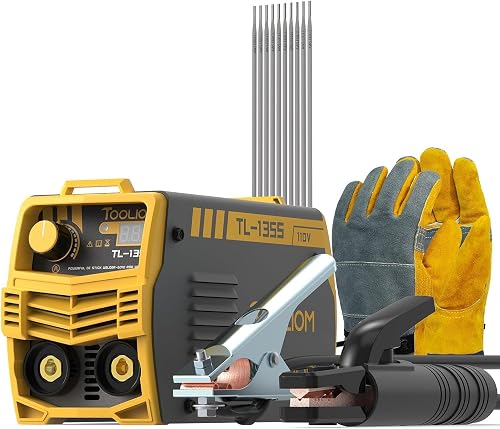
- 110V input only
- 135A model
- 8.73 lb stated weight
- Stick and lift TIG modes
The mini welder runs on standard 110V household power and offers stick or lift TIG mode. A lift TIG torch is not included.
Pros
- 110V household input
- Compact mini format
- Shoulder strap included
Cons
- Not for 220V input
- Lift TIG torch sold separately
The TOOLIOM 135A Mini is the choice for a home shop with 110V power only and a need for a compact machine. It supports stick and lift TIG, but the lift TIG torch is sold separately.
Its controls include a digital display, anti-stick, Arc Force and Hot Start. TOOLIOM describes it for 6011 and 6013 electrodes and for mild steel, cast iron, stainless steel and hard surfacing.
This is a 110V-only welder. Never connect it to 220V, which can damage the machine and create a fire risk.
Choose it for lighter work that fits the 135A model and household power. Skip it if you need dual-voltage flexibility, a higher output ceiling or a TIG torch in the package.
How do you choose the best stick welder for your home shop?
Choose the best stick welder by matching its input voltage and output range to your shop's supply and planned work. Then compare electrode guidance, controls, portability and included accessories so the setup fits your actual jobs.
How does the best stick welder fit your shop's outlet?
Start by checking the input voltage your outlet provides and the machine's instructions. A dual-voltage model gives you a choice of compatible supplies, but some machines provide different output ranges depending on input.
The ARCCAPTAIN 205A is a clear example: its stated maximum is 150A on 120V and 205A on 240V. The TOOLIOM 135A Mini is for 110V input only, so it won't suit a shop that needs a machine for 220V.
Don't assume an adapter changes the machine's input rating or makes every outlet suitable. Check the manual, cable and plug requirements, and circuit capacity before connecting a welder.
What output range should you look for in a stick welder?
Choose a current range based on the type of work and electrodes you expect to use, then confirm the machine can provide it on your available input. Maximum amperage is one part of the choice, not a guarantee that every job will suit the machine.
Lincoln's stated 10–225A range gives it the broadest range among these picks. DEKOPRO's 160A model may make more sense for projects that fit its lower output ceiling, while the ARCCAPTAIN 220A provides a stated range of 20–220A.
Also consider the duty cycle at the output you plan to use. Lincoln's stated 30% at 225A applies to 230V input; see our guide to reading welder duty cycle for help judging the rating.
Do you need a stick welder with lift TIG?
Buy a stick welder with lift TIG only if you plan to use both processes and have the right accessories. Lift TIG torch inclusion varies: TOOLIOM's 195A includes one, while the ARCCAPTAIN 200A, ARCCAPTAIN 205A and TOOLIOM 135A require a separate torch.
Lincoln's Weld-Pak 225i supports Touch Start TIG with additional accessories. DEKOPRO doesn't state a TIG mode in the details here, so choose another model if TIG is a must-have.
Compare accessory costs and setup requirements before buying a dual-process welder. Our guide to TIG versus stick welding explains how the processes differ in everyday use.
What weight and included gear matter for a stick welder?
A lighter welder is easier to carry between work areas and store after use. The ARCCAPTAIN 200A is stated at 7.2 lb, while Lincoln's Weld-Pak 225i is stated at 20 lb and includes cables, clamps, a strap and input adapters.
Check the package contents for the leads, holder, ground clamp and power adapter you need. TIG accessories can be separate even when the machine supports that process, so don't count on using TIG until you've confirmed the torch and other needed gear.
If you are building a first setup, our home welding starter kit guide covers the supporting gear to consider alongside the machine.
How should you set up and care for a home-shop stick welder?
Set up a stick welder by confirming its input, securing the work lead, choosing a compatible electrode and setting the current according to the machine manual and electrode guidance. Keep the work area clear, wear proper welding protection and let the machine cool as directed.
What should you check before striking an arc?
Read the manual first, especially the input voltage, connection and power-down instructions. Use a grounded outlet and a circuit suited to the machine, then place the work clamp on clean, stable metal with a solid electrical path.
Keep the electrode holder, cables and work lead in good condition. Arrange leads so they aren't pinched, sharply bent or crossing a walkway, and keep sparks away from anything that can catch fire.
Wear a welding helmet with a suitable shade, gloves, protective clothing and eye protection for chipping or brushing. The auto-darkening welding helmet guide can help you compare helmet features.
How do you choose an electrode and set current?
Choose an electrode that matches the metal, joint, position and machine's guidance. The models here mention common rods such as 6010, 6011, 6013 and 7018, but not every welder lists support for every type.
Start within the electrode maker's current range and adjust in small steps while keeping a steady arc. If the rod sticks, the puddle is hard to control or the arc behaves poorly, stop and check the current, ground connection, electrode condition and fit for the joint.
Automatic current matching can give a useful starting point, as on several ARCCAPTAIN models. It doesn't replace checking the machine manual or learning how the electrode behaves on your material.
How can you avoid common stick-welding mistakes?
Common problems include poor grounding, a current setting that doesn't suit the electrode, a long or unsteady arc, and rushing through slag removal. Check the setup and make one adjustment at a time so you can see what changes the result.
A sticking rod can point to settings, a weak connection or technique. Anti-stick and Hot Start features can help with electrode behavior, but they don't remove the need for sound setup and steady control.
After each pass, let the work cool as appropriate and remove slag with suitable tools before inspecting the weld. Don't weld over a dirty or poorly prepared area and expect machine features alone to compensate.
How should you store and maintain the machine?
Keep the welder dry, clean and stored so its cables and controls aren't damaged. Let it cool after use, check leads and clamps for wear, and follow the manual's instructions for cleaning, ventilation and service.
Don't block cooling vents or power the machine on while it is still completing a shutdown. ARCCAPTAIN's 200A and 220A models specifically instruct you to wait until the display goes dark and the fan stops before powering on.
Store electrodes as directed by their manufacturer. Keep the holder and ground clamp dry and free of damage, and replace worn or unsafe accessories before the next job.
Which best stick welder should you choose?
Choose the ARCCAPTAIN 200A for portable home-shop use and automatic current matching, the YESWELDER 205A for adjustable arc controls, or Lincoln's Weld-Pak 225i for its stated 10–225A range and included cable kit. Pick the TOOLIOM 135A Mini only if 110V-only input and its lower output fit your work.
If you need a TIG torch included, the TOOLIOM 195A is the clearest fit in this group. If app adjustments matter, consider the ARCCAPTAIN 205A, while checking that its output on your available supply meets your needs.
A best stick welder is the one whose input, output and accessories match your actual shop. For another process comparison, read our guide to MIG versus stick welding, or see whether a multi-process welder suits a home shop.
Our top 3 picks at a glance
-
1
-
2
-
3
Frequently asked questions
What should you look for in a stick welder for a home shop?
Match the welder's input voltage and output range to your outlet, rods and planned work. A dual-voltage model gives you more outlet options, while a 110V-only model can fit a shop with household power only.
Also compare weight, included leads, controls and whether lift TIG matters to you.
Is a 110V stick welder enough for home use?
A 110V model can suit smaller jobs and home shops that have household power but no 220V outlet. Its output range may be more limited than a dual-voltage machine, so compare the exact model's stated current range with your needs.
The TOOLIOM 135A Mini Stick Welder is 110V only.
Do you need a dual-voltage stick welder?
You need dual voltage only if you want the option to use both compatible 110V and 220V outlets. Check the machine's input requirements and the output it can provide at each voltage.
For example, the ARCCAPTAIN 205A has different stated current limits on 120V and 240V.
Can a stick welder also do TIG?
Some stick welders also support lift TIG, but you may need to buy a torch separately. The TOOLIOM 195A includes a lift TIG torch, while ARCCAPTAIN's 200A and 205A options state that the torch is not included.
Check the included accessories before choosing a machine for both processes.
How does duty cycle affect home-shop welding?
Duty cycle tells you how long a welder can run within a stated time period at a given output before it needs to cool. Compare the duty-cycle figure at the current you expect to use, since a machine can have different limits at different outputs.
Our guide to welder duty cycle explains how to read the rating.


