Does a Stick Welder Use Gas?
No, a stick welder does not use gas. The flux coating on the electrode burns and forms the shielding gas and slag that protect the weld, so a stick machine runs from the wall outlet and the rod alone.
On this page (8 sections)
- How does a stick welder shield the weld without gas?
- Which processes need gas and which don't?
- Why do so many people think stick welding needs gas?
- What do you need to run a stick welder at home?
- Does a stick welder need gas for TIG or other modes?
- When would you still want gas with a stick machine?
- Is stick welding a good choice for a first welder?
- What's the bottom line on gas and stick welding?
No, a stick welder does not use gas. The flux coating on the electrode makes its own shielding gas and slag as it burns, so the machine needs only the rod, the holder, the ground clamp and a power outlet.
If you're asking does a stick welder use gas before buying one for a home project, the short version is that stick welding is the gas-free process of the three common arc types.
That matters for cost and setup. There's no cylinder to rent, no regulator to buy and no hose to drag across the garage floor.
What you give up is some speed and neatness compared with gas-shielded MIG, which is a fair trade for many home jobs.
How does a stick welder shield the weld without gas?
The shielding comes from the rod itself. A stick electrode is a metal core wrapped in a flux coating, and as the arc burns, that coating melts and vaporizes around the weld pool.
The burning flux pushes oxygen and nitrogen away from the molten metal. Those gases would otherwise cause porosity and weak, brittle welds in steel.
The flux also leaves a hard slag layer that keeps protecting the bead as it cools.
Different rod types handle this differently, which is why the flux formula changes with the electrode number. A 6011 rod's flux is designed to burn through light rust and paint, while a 7018 rod's coating is formulated for a smoother, stronger deposit on clean steel.
The rod does the shielding job in both cases, just with a different recipe.
You chip that slag off after each pass. Underneath is the finished weld.
So when people ask does a stick welder use gas, the honest answer is that the gas is generated right at the arc rather than piped in from a bottle.
Which processes need gas and which don't?
Gas shielding belongs to the wire-feed processes. MIG welding with solid wire needs an external shielding gas, usually an argon and carbon dioxide mix for mild steel.
That's why MIG setups include a cylinder and regulator.
Flux core wire is the exception on the wire side. It's a hollow wire filled with flux, so it shields itself the same way a stick rod does.
That's why gasless flux core is popular for beginners on a budget.
Stick and flux core both run without a cylinder. TIG with most metals needs argon, and MIG with solid wire needs its mix.
For a side-by-side breakdown of the two home favorites, see stick welder vs flux core.
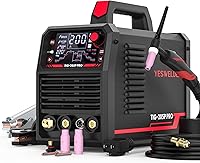
The machine itself usually tells you which camp it's in. A pure stick welder like the YESWELDER 205A has no gas inlet or solenoid at all, so there's nothing to hook a hose to.
Its outputs are the electrode holder lead and the ground clamp lead, and that's the whole setup.
Why do so many people think stick welding needs gas?
The confusion comes from welding videos and shop tours. A MIG machine often sits next to a tall gas cylinder, so viewers assume all welding needs one.
A stick machine usually has no bottle in sight.
The rods themselves also look gas-related. A 7018 rod's flux coating is easy to mistake for something that gets connected to a hose.
It isn't. The coating is the shield.
Stick welding is also called SMAW, or shielded metal arc welding. That "shielded" word in the name refers to the flux coating, not to an external gas supply.
A stick welder is a self-contained process, which is part of why it's still used on job sites and farms.
The guides that ship with combo machines add to the muddle. A stick and TIG machine's manual covers both modes in one booklet, so gas valves and torch fittings show up on pages that have nothing to do with stick rods.
Read the stick section only and the gas question disappears.
What do you need to run a stick welder at home?
You need the machine, an electrode holder, a ground clamp, the right rods and a suitable outlet. No gas cylinder, regulator or hose is part of the kit.
A basic inverter stick welder like the YESWELDER 205A runs on 110V or 220V and supports common rods such as 6010, 6011, 6013 and 7018. It also has hot start and arc force controls to help the arc strike and stay lit.
The YESWELDER machine comes with a 220V to 110V adapter, so you can move between a garage outlet and a dryer or shop circuit as your work grows. It weighs about 8.4 lbs and has a carry handle, which suits driveway and farm repairs where you carry the box to the job.
Check your outlet and breaker before you buy. A 220V circuit gives you more headroom for thicker steel, while 110V suits lighter work and garages without a dedicated line.
You'll also want safety gear: a helmet with the right shade, gloves, a jacket and something to chip slag. Our ARCCAPTAIN stick welder review covers what to expect from one popular beginner machine.
Does a stick welder need gas for TIG or other modes?
No gas is needed for the stick mode, but a combo machine changes the answer for its TIG side. Lift TIG welding needs argon in most cases, so a stick and TIG combo requires a cylinder when you switch to TIG.
The ARCCAPTAIN 220A runs stick or lift TIG, and its TIG torch is sold separately. In stick mode it runs on the rod's flux alone.
In lift TIG mode you'll need a gas supply for the torch.
That matters if you plan to add TIG later. Budget for a small argon cylinder and regulator alongside the torch.
If you only plan to stick weld, ignore that part of the machine.
The controls on this one are also different from a plain stick box. Its LCD is a 3.2-inch screen and shows current from 20 to 220A, plate thickness from 0.04 to 0.47 inches, hot start from 0 to 60A and arc force from 0 to 100A.
The synergic control can match current after you pick the rod diameter, which is handy before you've learned to dial settings by ear.
Even with that screen and the TIG port, stick mode still needs no gas. Only the lift TIG setting pulls in the cylinder.
When would you still want gas with a stick machine?
You wouldn't use gas with a stick rod. Gas only enters the picture when the same machine or a second machine runs a gas-shielded process.
A multi-process welder is the usual reason a home shop ends up buying a cylinder.
The ARCCAPTAIN MIG200 covers gas MIG, gasless flux core, stick and lift TIG in one box. In its gas MIG mode it needs a shielding gas supply.
In stick and flux core modes it doesn't.
This is the machine that makes the gas question worth asking carefully. Its MIG side takes solid wire in .023, .030 and .035 inch, plus .035 and .040 inch aluminum wire through a spool gun connector that's sold separately.
The flux core side takes .030 and .035 inch wire, and that mode runs without gas.
How to tell which mode you're in
The mode you select on the panel decides whether gas is involved. Choose stick or flux core and the machine runs on the rod or wire's own flux.
Choose gas MIG and the cylinder and regulator become part of the setup.
If your projects are steel brackets, repairs and fence work, stick or flux core does the job without gas. If you want clean sheet metal or aluminum, a gas-shielded MIG setup earns its place.
Compare the two in MIG welder vs stick welder.
Is stick welding a good choice for a first welder?
Yes, for many home users. Stick welding has fewer setup steps than gas MIG, so you spend more time learning the arc and less time managing a bottle.
It also handles dirty, rusty or painted steel better than most processes.
The rods are cheap and sold in small packs. You can weld outside on a breezy day because the flux shield doesn't blow away.
That's a real advantage for driveway repairs and farm equipment.
The trade-offs are real too. You'll spend time chipping slag, and thin sheet metal is harder to run without burning through.
Stick shines on 1/8-inch steel and up. If your project is thin sheet or you want neat cosmetic beads, a wire-feed machine fits better.
What's the bottom line on gas and stick welding?
Stick welding uses no gas. The flux coating on the rod shields the weld, so the process runs on the rod, the machine and an outlet.
If that's what you wanted to confirm before choosing a welder for a home project, you're set.
Pick a stick welder for thicker steel, outdoor work and repairs where you don't want a cylinder. Pick a gas MIG or a multi-process machine if you need clean sheet metal, aluminum or the option of both.
Our best stick welders for home shops guide compares the machines that fit each path.
Frequently asked questions
Does a stick welder use gas?
No. A stick welder runs without a gas cylinder.
The flux coating on the electrode burns in the arc and creates the shielding gas and slag that protect the molten weld from the air.
Can I use a stick welder outdoors?
Yes. Because the flux makes its own shielding, a light breeze won't blow the protection away the way it can with bare-wire MIG.
You still want some shelter from heavy rain or strong wind for comfort and arc stability.
What gas does a MIG welder need that a stick welder doesn't?
MIG welding with solid wire needs a shielding gas, usually a mix of argon and carbon dioxide for steel. A stick welder skips the cylinder because the rod's flux does that job inside the arc.
Do I need a gas cylinder to weld with a stick welder?
No cylinder is needed. You need the welder, an electrode holder, a ground clamp, and the right rods for your metal.
The gas comes from the burning flux, not from a bottle.
Can a stick welder run flux core wire?
No, a stick welder uses covered electrodes only. Flux core wire needs a wire feeder, so that job belongs to a MIG or flux core machine.
Is stick welding harder without gas?
Not harder in that way. The flux handles shielding, so you focus on arc length, travel speed and rod angle.
The main skill is keeping a steady arc and chipping the slag afterward.