Is a TIG Welder an Arc Welder?
Yes, a TIG welder is an arc welder. TIG is one of several arc welding processes, so it melts metal with an electric arc; the difference is that TIG uses a non-consumable tungsten electrode and a separate filler rod, while stick uses a coated electrode that melts into the weld.
On this page (8 sections)
- Is a TIG welder an arc welder?
- How does TIG differ from stick arc welding?
- What do TIG and stick welders have in common?
- How do TIG machines differ by type and material?
- Which arc process fits a home project?
- What does each process need to run?
- What should you check before buying an arc welder?
- So, is TIG an arc welding process?
Yes, a TIG welder is an arc welder. TIG is one process inside the arc welding family, so the arc is what melts the metal in both cases.
What changes is how the arc is struck, what carries the filler, and what you need at your bench. That matters when you're picking a machine for a home project, because "arc welder" covers a wide range of tools and each one asks for different skills, power and gas.
The short version: TIG gives you control and clean beads, especially on thin metal. Stick gives you simplicity and reach on thick or dirty steel.
Read on for how the two connect, where they differ, and which one fits the job in front of you.
Is a TIG welder an arc welder?
Yes. A TIG welder is an arc welder, because TIG is one of the arc welding processes.
The arc is the heat source in TIG just as it is in stick, MIG and flux-cored welding. So a TIG machine belongs under the same umbrella as the older "arc welder" your local shop might sell.
The confusion comes from everyday speech. Many people say "arc welder" when they mean a stick welder, the buzzy, cheap, coated-electrode machine.
TIG is a newer and more precise process, but it still creates and controls an electric arc between an electrode and the work.
That's why a TIG machine often lists "arc welding" in its specs. The LOTOS TIG200ACDC, for example, combines a TIG torch with DC stick arc capability in one box.
If the question is whether the process is arc welding, the answer is yes for both.
How does TIG differ from stick arc welding?
TIG uses a non-consumable tungsten electrode and a separate filler rod, while stick uses a coated electrode that melts as both filler and shield. That one difference changes the whole experience at the bench.
In TIG, the tungsten electrode creates the arc and stays intact. You feed filler wire by hand into the pool, so you control how much metal goes in.
A gas shield, usually argon, protects the molten pool.
In stick, the coated electrode is the filler. Its coating burns off to create the shielding gas.
You drag or strike the rod and move along, and the rod gets shorter as you weld. Our ARCCAPTAIN 200A stick welder review shows what that setup looks like in a home machine.
What do TIG and stick welders have in common?
Both use an electric arc to melt metal, both need a ground clamp and both come in machines you can run at home. The shared basics are the reason the two are grouped together, and knowing them helps you choose.
Each machine needs a work lead clamped to clean metal to complete the circuit. Each needs the right electrode for the material and thickness.
Each produces a weld pool that you move along the joint.
Many modern TIG machines also include a stick mode, so one box covers both processes. That's a common layout in this category and a practical way to get TIG precision plus stick reach without buying twice.
How do TIG machines differ by type and material?
TIG machines split mainly by current type and by what they can weld. A DC-only TIG suits steel and stainless; an AC/DC TIG adds aluminum.
Pulse TIG adds control for thin material.
DC TIG is the simpler and cheaper path. It handles mild steel and stainless well and gives clean beads on thin sheet.
It won't give you the cleaning action that aluminum needs.
AC TIG adds alternating current, which breaks up the oxide layer on aluminum. If you want to know more, our guide on whether you can weld aluminum with a TIG welder walks through it.
Pulse TIG adds an on-off current cycle that helps on very thin stock.
Which TIG welder is best for a beginner at home?
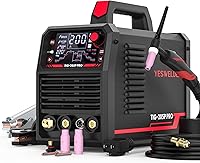
The YESWELDER TIG-205P is the strongest all-round pick here for a beginner, because it packs stick, DC TIG and pulse TIG into one light box. Its 200 amps cover hobby projects and light professional work, and the LED screen shows your settings clearly.
It runs on 110V or 220V and switches automatically, so it plugs into a home outlet without a manual change. High-frequency start means you don't have to scratch the tungsten to strike an arc.
A 5-pin foot pedal interface is there if you want to add a pedal later. One caution: YESWELDER says the TIG-205P cannot weld aluminum.
For aluminum work, go AC/DC.
Which TIG welder is best for aluminum and mixed projects?
The Lincoln Electric Square Wave 205 is the pick for aluminum and mixed work, since it's an AC/DC TIG unit with frequency and balance controls. Those two dials let you tighten or widen the bead and set more cleaning action on dirty aluminum.
It also stick welds from the same power source, which helps on outdoor jobs or thicker steel. It runs on 120V or 230V and weighs about 36 lb, so it moves around a shop without much fuss.
The package includes a foot control, a gas regulator and a torch. If you want to compare TIG against the other main home process, see TIG vs MIG welder.
Which arc process fits a home project?
Pick TIG for thin, clean, visible work and stick for thick, dirty or outdoor metal. That single rule covers most home decisions, and the material and thickness in front of you settles the rest.
TIG suits furniture frames, thin tube, stainless trim and auto body panels. It gives tidy beads with little spatter, and you can control heat closely.
The trade-off is slower travel and the need for gas and clean metal.
Stick suits gates, trailers, repairs and anything thick or rusty. It's more forgiving of dirt and wind, and you don't need gas.
The trade-off is more spatter and less finesse on thin stock. A multi-process machine lets you keep both options.
What does each process need to run?
TIG needs a gas shield, a clean work area and usually a foot control or torch switch, while stick needs only power and electrodes. Setup is where the two diverge most for a home shop.
TIG needs argon, a regulator and a flow meter. The work has to be clean, since oil and rust spoil the pool.
Many users add a foot pedal for heat control; the LOTOS TIG200ACDC includes one in its package.
It offers 10 to 200 amps on TIG and 15 to 200 amps on DC stick, and it runs on 110V or 220V. That dual voltage matters if your shop outlet is limited.
The kit also includes a torch, a ground clamp and a consumable set.
Stick needs less gear: power, a holder, a ground clamp and electrodes. No gas bottle and no pedal.
That's why stick remains the cheap, portable choice for repairs away from the bench.
What should you check before buying an arc welder?
Check the process modes, the input voltage and the duty cycle first. These three decide whether a machine fits your shop, your outlet and the length of your projects.
Look for a clear mode switch between TIG and stick if you want both. Check whether the TIG side is DC only or AC/DC; AC/DC costs more but opens aluminum.
Confirm the voltage against your outlet, and whether it switches automatically.
Duty cycle tells you how long you can weld before the machine needs to cool. A low duty cycle means more waiting on long beads.
Also check what's in the box, since a torch, regulator or pedal can add real cost.
For beginner-focused options, browse our list of the best TIG welders for beginners to compare machines by feature and use.
So, is TIG an arc welding process?
Yes. A TIG welder is an arc welder, and so is a stick welder.
The arc does the melting in both; TIG just controls it with a tungsten electrode, separate filler and a gas shield. That's the answer to whether TIG counts as arc welding, and it's the key to picking a machine.
For a home shop, pick TIG if your work is thin, clean and visible. Pick stick if it's thick, dirty or outdoors.
If you want both, a multi-process TIG machine like the YESWELDER TIG-205P covers most hobby work, while the Lincoln Electric Square Wave 205 adds aluminum capability.
Check your outlet and your material before you buy. Then match the process to the job, not the label on the box.
Frequently asked questions
Is TIG welding the same as arc welding?
TIG is a type of arc welding, so the two terms overlap but aren't identical. Arc welding is the broad family that includes TIG, stick, MIG and flux-cored; TIG describes the specific process that uses a tungsten electrode and separate filler rod.
Can a TIG welder also stick weld?
Many TIG machines include a stick mode. The LOTOS TIG200ACDC and the YESWELDER TIG-205P both switch to DC stick, while the Lincoln Electric Square Wave 205 offers TIG and stick from one power source.
Check the mode switch before you buy.
What is the difference between TIG and stick welding?
TIG uses a tungsten electrode that doesn't melt and a filler rod you feed by hand, which gives clean, precise beads. Stick uses a coated electrode that burns away as filler, so it's simpler to set up and works better on dirty metal and outdoors.
Do I need gas for TIG welding?
Yes, TIG uses a shielding gas, usually argon, to protect the molten pool from the air. The LOTOS TIG200ACDC and the Lincoln Electric Square Wave 205 both ship with a gas regulator.
Stick welding needs no gas because the electrode coating provides the shield.
Which is better for a home workshop, TIG or stick?
TIG gives cleaner welds on thin steel, stainless and aluminum, so it suits furniture and auto work. Stick is cheaper and more forgiving on thick, dirty or outdoor metal.
Many home shops pick a multi-process machine so they can use both.