Can You Weld Aluminum With a TIG Welder?
Yes, you can weld aluminum with a TIG welder. You need an AC-capable TIG machine, pure argon shielding gas, a dedicated aluminum setup and clean metal; DC-only TIG welders are not the right tool for it.
On this page (8 sections)
- Can you weld aluminum with a TIG welder at home?
- Why does aluminum need AC TIG instead of DC?
- What setup do you need to TIG weld aluminum?
- Which TIG welder handles aluminum for a home shop?
- What settings do you start with for aluminum TIG?
- Which helmet and safety gear does aluminum TIG work need?
- Should you buy an AC TIG welder or a DC-only one?
- What should you know before you try aluminum TIG?
Yes, you can weld aluminum with a TIG welder. The catch is the machine: you need AC output, pure argon gas and a clean aluminum setup, and a DC-only TIG welder won't do the job well.
This guide covers what changes when the metal is aluminum and which home machines make it practical.
Can you weld aluminum with a TIG welder at home?
Yes, and AC TIG is the standard home method for aluminum. A TIG welder with AC output switches polarity many times a second, and that alternating current is what makes aluminum workable.
Aluminum is tricky because it forms an oxide layer almost instantly, and that layer melts at a much higher temperature than the metal underneath. The positive half of the AC cycle breaks up the oxide so the puddle can form; the negative half does the heating and penetration.
A DC-only TIG machine gives you one polarity and no cleaning action, so the oxide fights the arc and the weld looks dirty or won't fuse.
The practical test is simple: look for "AC/DC" in the machine name or specs. A machine sold as "TIG-200DC" or "DC TIG only" is for steel and stainless, not aluminum.
Our guide to can you weld aluminum with a MIG welder covers the faster alternative if speed matters more than finish.
Why does aluminum need AC TIG instead of DC?
AC cleans the oxide and heats the metal in one cycle; DC TIG can't do both at once on aluminum. That is the whole reason aluminum has its own settings.
Balance and frequency controls on better machines let you fine-tune the bead. Balance sets how much of the cycle spends time cleaning versus penetrating.
More cleaning action helps on dirty aluminum; more penetration helps on thicker stock. Frequency changes the shape of the bead and how tight the arc cone stays.
Aluminum also conducts heat away fast, so you need more amps than on steel of the same thickness.
What setup do you need to TIG weld aluminum?
You need 100% argon gas, aluminum filler rod, the right tungsten and clean metal. Each piece plays a part, and skipping one shows up in the bead.
- Gas: use 100% argon. Argon gives the stable arc and the cleaning action that AC TIG relies on. CO2 mixes are for other processes and won't give you clean aluminum TIG.
- Filler: ER4043 is the easy all-round choice for beginners, and ER5356 suits stronger, more crack-resistant joints. Thin sheet takes 1/16 inch or 3/32 inch rod.
- Tungsten: pure tungsten or lanthanated tungsten works for aluminum, balled on the end in AC. Keep a dedicated tungsten for aluminum so steel work doesn't contaminate it.
- Clean metal: wipe off oil and grease, then remove the oxide with a stainless brush kept only for aluminum. A dirty surface is the most common cause of a bad aluminum TIG weld.
- Torch setup: a gas lens helps keep shielding gas steady over the puddle. Feed filler by hand, so there's no wire liner or spool gun involved as there is with MIG.
Once a torch, brush or tungsten has touched steel, it carries contamination into the aluminum weld.
Which TIG welder handles aluminum for a home shop?
An AC/DC TIG welder with square wave output is the right buy for home aluminum work. Two machines here cover that need, and both run on household current.
YESWELDER TIG-200P AC/DC
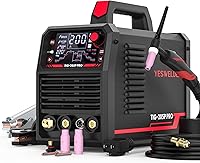
The YESWELDER TIG-200P AC/DC is the practical pick for a first aluminum TIG welder. It delivers up to 200 amps and runs on 110V or 220V with auto-sensing dual voltage, so it plugs into a home outlet or a shop circuit without manual switching.
It's rated for aluminum up to 1/8 inch thick.
The machine is a 7-in-1 unit covering AC TIG, DC TIG, AC and DC Pulse TIG, MIX TIG, STICK and Spot Welding. Its software-controlled square wave runs in sine, triangle and square shapes, and AC mode is set up for cleaner aluminum welding while DC handles steel.
A 5-pin foot pedal interface lets you add a pedal to control current. It weighs 16.47 lb (7.47 kg), so it's easy to carry between the bench and the garage.
The box includes a 13 ft WP-26 TIG torch, a 220V to 110V adapter, a ground clamp and electrode holder, and TIG torch consumables. Hot Start helps ignition and an auto memory function saves your settings.
Lincoln Electric Square Wave 205
The Lincoln Electric Square Wave 205 (K5613-1) is the step up for someone who wants more control over the aluminum bead. It's an AC/DC TIG welder and a stick welder in one power source.
The AC Frequency Control adjusts the bead wider or tighter, and AC Balance changes the cleaning action on dirty aluminum or pushes penetration on thick material.
It runs on a standard 120V circuit or 230V for maximum output, and it weighs 36 lb (16 kg). The kit includes a Caliber 17 TIG torch Ready-Pak, a K870 Foot Amptrol, a gas regulator and flowmeter with a 10 ft gas hose, a 200A stick electrode holder, a ground clamp and cable, and 120V and 230V adapters.
The included foot control is a real advantage for aluminum work, where current control as the puddle forms matters more than on steel.
What settings do you start with for aluminum TIG?
Start on AC, set balance toward more cleaning, and match amps to the thickness. A square wave machine with balance and frequency control gives you room to adjust.
Thin sheet in the 1/16 inch to 1/8 inch range is where most home aluminum projects sit. Run low amps and keep the arc moving so the metal doesn't sag or blow through.
If the puddle looks dull or the filler won't flow in, add cleaning action or check the gas flow. If the weld sits on top without fusing, you need more amps or a slower travel speed.
Keep the tungsten out of the puddle. A balled tungsten in AC is normal; a tungsten dipped in the puddle will spit and need cleaning.
Practice on scrap of the same thickness before you touch the real part.
Which helmet and safety gear does aluminum TIG work need?
You need a proper auto-darkening helmet set to the right shade, plus gloves and good ventilation. Aluminum TIG runs a bright arc with high UV, so eye protection matters as much as with any process.
The Hobart 770890 is an auto-darkening helmet with a 9.3 inch widescreen viewing area and PureColor Lens technology for an accurately colored, clearer view of the puddle. It has four independent arc sensors for quick arc detection, continuous UV and IR protection, and an auto-on/off power control that triggers the lens at the strike of an arc.
Analog knobs set shade, sensitivity and delay, and a Weld to Grind mode switch keeps the lens clear for grinding without changing helmets. It runs on one CR2 battery, included, and weighs 1.25 lb.
It accepts magnifying cheater lenses sold separately. Hobart backs it with a limited 2 year manufacturer's warranty.
Keep the area ventilated. Aluminum TIG doesn't produce much spatter, but the arc is bright and ozone builds up in a closed space.
Wear leather gloves and cover exposed skin.
Should you buy an AC TIG welder or a DC-only one?
Buy an AC/DC TIG welder if aluminum is on your project list; buy a DC-only TIG if it's steel and stainless only. That single spec decides whether the machine can do the job you're asking about.
A DC-only TIG welder is cheaper and fine for steel and stainless, but it locks you out of aluminum. An AC/DC machine costs more and does both.
For a home shop doing mixed projects, the AC/DC machine is the more useful buy, and the 200 amp class covers thin aluminum well. Our guide to best TIG welders for beginners compares starter machines on this point.
If you're still deciding between processes, our TIG vs MIG welder comparison lays out when each one earns its place. For aluminum specifically, TIG gives you the cleaner, more controlled bead.
And if you're weighing a cheaper entry point, can you weld aluminium with a stick welder explains why stick is the weakest option for this metal.
What should you know before you try aluminum TIG?
Clean the metal, practice on scrap, and accept that aluminum TIG takes more time than steel. The settings and the hand control both need practice, and the payoff is a clean, controllable weld on a metal that's hard to join any other way at home.
Start with thin scrap of the same thickness as your project and run beads until the puddle behaves. Check the gas supply and the ground before you strike an arc.
When the bead looks dull or the filler won't flow in, change one setting at a time rather than several.
For a home project, the YESWELDER TIG-200P AC/DC covers aluminum TIG up to 1/8 inch on household voltage. The Lincoln Electric Square Wave 205 gives you more control and a foot control in the box.
Pick the YESWELDER for a first machine and the Lincoln if you plan to weld aluminum often. Either way, the answer to can you weld aluminum with a TIG welder is yes, once the machine runs AC.
Frequently asked questions
What gas and filler do you need for aluminum TIG welding?
Use 100% argon shielding gas and an aluminum filler rod such as 4043 or 5356. Argon gives the stable arc and cleaning action AC TIG needs.
ER4043 is the easier all-round choice for beginners, while ER5356 suits stronger, more crack-resistant joints.
Is TIG or MIG better for welding aluminum at home?
TIG gives cleaner, more controlled welds and suits thin aluminum and visible work. MIG is faster and easier to learn on thicker aluminum.
For a beginner doing small projects, an AC TIG welder is the more useful first machine.
Do you need a special torch or liner to TIG weld aluminum?
No liner is needed because TIG feeds filler by hand. You do need a TIG torch with the right tungsten, usually pure or lanthanated for aluminum, and a gas lens helps keep the shielding gas steady.
A separate torch setup keeps aluminum work clean.