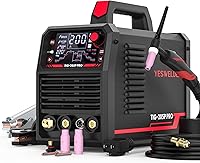
Are Hand Held Arc Welders Any Good?
Yes, hand held arc welders are good for light home work. A 110V stick welder handles repairs on mild steel, cast iron and stainless steel up to about 1/8 inch thick, as long as you accept its duty cycle and rod-striking skill requirement.
On this page (8 sections)
- Are hand held arc welders any good for home projects?
- What makes a hand held stick welder different from a full-size unit?
- How does a 110V hand held arc welder perform on real jobs?
- Are hand held arc welders hard to learn?
- Which hand held arc welder fits which home job?
- Are hand held arc welders safe and practical to use?
- What should you check before buying a hand held arc welder?
- So, are hand held arc welders any good?
Yes, hand held arc welders are good for light home work. A 110V stick welder handles repairs on mild steel, cast iron and stainless steel up to about 1/8 inch thick, as long as you accept its duty cycle and rod-striking skill requirement.
The "hand held" part just means the machine is small and light enough to carry from the bench to the gate. The welding itself still works like any stick welder: you clamp a ground, strike an electrode against the metal, and control the puddle by hand.
The size of the box changes what you can power and how long you can run, not how the arc behaves. That's the whole answer in a nutshell, and the sections below cover where these machines earn their place.
Are hand held arc welders any good for home projects?
They are good for repair work on thin to medium steel, not for production welding. A hand held arc welder is a 110V inverter unit that runs stick electrodes and weighs around 8 to 10 lb.
That makes it a realistic tool for a garage, farm or job site where a 220V circuit isn't available.
The trade-off is thickness and time. A 110V machine delivers enough current for 6011, 6013 and 7018 rods on steel up to roughly 1/8 inch.
On thicker metal you can run multiple passes, but the duty cycle will force breaks. If you understand what an arc welder is and how the electrode melts into the joint, these limits stop being surprises.
For the typical home job, a broken trailer bracket, a gate hinge, a lawn mower deck, a hand rail post, a hand held unit covers the work. It is not the right machine for 1/4 inch plate or all-day structural fabrication.
What makes a hand held stick welder different from a full-size unit?
The difference is input power, weight and duty cycle, not the welding process. A full-size stick welder usually runs 220V and can hold a high amperage for long stretches.
A hand held model runs 110V household current and trades that power for portability.
That matters in three ways. First, the 110V input caps the output, so you get fewer amps and thinner capability.
Second, the small transformer or inverter package heats up faster, so the duty cycle is short and you weld in bursts. Third, the light weight lets one person carry it and set up almost anywhere there's an outlet.
The arc itself still behaves like stick welding, so the skill you build on a hand held unit transfers to a bigger machine later. The controls are simpler too.
Most hand held models offer hot start, arc force and anti-stick, which help beginners strike and hold an arc.
How does a 110V hand held arc welder perform on real jobs?
It performs well within its thickness limit and struggles past it. On 1/8 inch mild steel, a 135A to 205A hand held unit lays a solid bead with 6013 or 7018 rods.
On 3/16 inch steel you'll feel the puddle cool and the arc get unstable, and the duty cycle warning light will come on sooner.
That's the honest picture. A hand held arc welder is good on sheet, tube and small brackets, and it's not good on heavy plate.
Buyers who expect to repair a tractor frame or build a trailer need a 220V machine. Buyers fixing a gate, a fire pit grate or a mower deck will find a 110V unit does the job.
The other real limit is stick welding itself. You can't just point and pull a trigger.
You strike, hold a short arc, and move at a steady speed. A beginner will stick the rod a few times before it clicks.
The hot start feature helps, but practice on scrap is what actually teaches the hand.
Are hand held arc welders hard to learn?
They are moderately hard to learn, and easier than they used to be. Stick welding has the steepest learning curve of the common home processes because the arc length is controlled entirely by your hand.
The rod has to stay close to the metal without touching it.
Modern inverter units soften that curve. Anti-stick reduces the rod fusing to the workpiece when you hesitate.
Hot start gives a brief current boost so the arc strikes on the first tap. Arc force pushes current up when the arc gets short, which keeps the puddle from freezing.
You still need to practice. Burn a few rods on flat scrap before you weld anything structural.
Start with 6013 rods, which strike more easily than 7018, and keep your travel speed steady. A hand held machine's small size makes this practice cheap because it's easy to set up and put away.
Which hand held arc welder fits which home job?
Pick by thickness and by whether you want stick only or a machine that does more. The three options below cover the usual home projects.
None of them needs a 220V outlet except the dual-voltage unit when you run it on 220V.
Best for thicker steel and dual voltage
The YESWELDER 205A Stick Welder is the strongest pick here for heavier home repairs. It delivers up to 205A and runs on either 110V or 220V, so you can use household current for light jobs and a 220V circuit for thicker steel.
Hot Start and Arc Force adjust across 10 levels, and anti-stick helps keep the rod from fusing when you hesitate. It handles 6010, 6011, 6013 and 7018 rods and weighs about 8.4 lb with a carry handle.
The 205A output is what makes this the one to choose when your projects run past 1/8 inch steel. It's the top of the three for anyone who wants room to grow.
Best for one machine that does MIG and stick
The ARCCAPTAIN 135A MIG Welder runs flux core gasless MIG, stick and lift TIG from one 110V box. That matters if your projects mix thin sheet with occasional stick work.
For stick welding you can set Hot Start and Arc Force from 0A to 60A. In MIG mode the machine matches wire feed speed and voltage to your wire size and metal thickness, which shortens the setup for a beginner.
It weighs about 9.5 lb and comes with a shoulder strap. Choose it if you want more than stick welding from a single small machine.
Read the full ARCCAPTAIN stick welder review for the details on how it handles electrodes.
Best for small jobs and tight spaces
The TOOLIOM 135A Mini Stick Welder is the lightest and simplest option. It's a 2-in-1 stick and lift TIG unit on 110V only, at about 8.7 lb with an adjustable shoulder strap.
It handles 6011 and 6013 electrodes on mild steel, cast iron and stainless steel, and includes anti-stick, arc force and hot start for easier starts. A digital display shows the output current.
The 110V-only input is the limit to know: connecting it to 220V will damage the machine. Pick it for light repairs and small spaces where a full-size unit is overkill.
A lift TIG torch isn't included, so TIG work means buying the TOOLIOM TL-WP-17V-10-25 torch separately.
Are hand held arc welders safe and practical to use?
They are safe when you respect the input voltage and wear the right gear. The biggest real risk with these machines is plugging a 110V-only unit into a 220V outlet.
The TOOLIOM warns that this causes immediate damage and fire risk, so check the outlet before you connect anything.
The rest is standard welding safety. Wear a welding helmet with a proper shade lens, leather gloves and long sleeves.
Keep flammable material out of the spark zone and work in a ventilated area, because stick welding gives off fumes from the electrode coating. Clamp your ground close to the weld so the current path stays short.
Practicality is the other half. A hand held unit sets up in a minute on a bench or in a driveway.
It runs from an outlet you already have, so you don't need an electrician for a 220V circuit. That convenience is the main reason these machines sell well to home users.
What should you check before buying a hand held arc welder?
Check the input voltage, the rod sizes it supports, the output amps and the weight. The input voltage is the first filter.
A 110V-only machine limits you to household outlets and caps thickness.
A dual-voltage machine costs more but gives you a 220V path later.
Then look at rod compatibility. If your projects call for 7018 rods, confirm the machine lists them.
Check the output amps against your thickest planned steel. Weigh the machine if you'll carry it often, since 8 to 10 lb feels different up a ladder than on a bench.
Compare a few models side by side in our guide to the best stick welders for home shops before you commit. If you also want TIG work, a TIG welder for beginners gives you more control on thin metal.
And keep your first rods in mind when you compare prices.
So, are hand held arc welders any good?
Yes, for the right jobs. A hand held arc welder is good when you need to repair steel up to about 1/8 inch, want to run from a household outlet, and don't mind learning to strike an arc.
It's not good for thick plate or long production runs.
Pick the YESWELDER 205A if you want the strongest machine and the option of 220V later. Pick the ARCCAPTAIN 135A if you want stick and flux core MIG in one unit.
Pick the TOOLIOM 135A Mini if light repairs and a small footprint matter most. For anything past 1/8 inch steel or all-day work, step up to a full-size 220V stick machine instead.
Frequently asked questions
Can a hand held arc welder weld aluminum?
No, a standard stick welder runs DC or AC stick electrodes made for steel and cast iron. Aluminum needs a TIG setup with AC output or a spool gun on a MIG machine, so plan a different tool for aluminum jobs.
How thick can a 110V hand held arc welder weld?
Expect clean welds on steel up to roughly 1/8 inch thick in a single pass. Thicker steel is possible with a 205A-class machine and multiple passes, but the duty cycle limits how long you can weld before it needs to cool.
Do I need special training to use a hand held arc welder?
You don't need a license, but stick welding does take practice. Plan on burning a few rods on scrap steel to learn arc length and travel speed, and use the Hot Start and Arc Force settings to make striking the arc easier.
What rods should a beginner buy for a hand held arc welder?
Start with 6013 rods in 1/16 or 5/64 inch for thin steel and easier striking. Move to 7018 rods for stronger joints on thicker metal once you can keep a steady arc without sticking the rod.