Are MIG Welders AC or DC?
MIG welders run DC output, even though they plug into AC wall power. The machine turns that alternating current into steady direct current so the wire feeds and the arc stays stable. A few dual-purpose units also offer AC, but DC is the standard for MIG.
On this page (9 sections)
- Are MIG welders AC or DC in normal use?
- Why does DC output suit MIG welding so well?
- What about the machines that say AC on the label?
- Does DC help with thin sheet and auto body work?
- Which current type fits a 230V machine?
- How do you pick the right DC MIG welder for a home project?
- Does current type change how you set up gas and wire?
- Are there times when AC output makes sense?
- What should you check before you buy?
Are MIG welders AC or DC? A MIG welder runs DC output, even when it draws AC from the wall.
The internal power supply converts the alternating wall current into direct current, which keeps the wire feed and the arc steady.
A handful of multi-process machines also offer an AC setting, but DC is the norm.
That matters for a home project because DC gives you a calmer arc and less spatter on thin steel. The type of current a MIG welder uses is set by the machine's design, not by the outlet in your wall.
Are MIG welders AC or DC in normal use?
Normal MIG welding runs on DC, specifically electrode-positive DC, which most people write as DCEP. The wire is the positive electrode, and the workpiece is negative.
This setup pushes heat into the wire so it melts fast and lays down a smooth bead.
The confusion comes from the input side. A welder plugs into AC mains at 115V or 230V.
Inside, a rectifier and smoothing components turn that AC into DC for the welding circuit. So the answer to are MIG welders AC or DC is DC on the output, AC on the input.
Some machines carry a dual rating. A multi-process welder might offer AC for stick or TIG and DC for MIG.
That's a machine feature, not the MIG process itself. When you see a spec sheet list "power source: AC," it usually describes what the unit draws from the outlet.
Why does DC output suit MIG welding so well?
DC holds the arc steady, and a steady arc is what MIG depends on. The process uses a continuously fed wire that has to melt at a predictable rate.
Direct current keeps that melt rate even, so the bead stays consistent as your hand moves.
With alternating current, the direction flips many times per second. The arc cools and re-strikes in step with those flips.
That produces more spatter, a rougher bead and a narrower usable current range. For thin sheet metal, the difference shows up quickly as burn-through or a lumpy surface.
DC also makes the wire feed behave. The drive rolls push wire into the pool at a set speed, and a stable arc lets that speed translate into an even deposit.
That's why almost every dedicated MIG welder, from a budget 110V unit to a 230V workhorse, is built around DC output.
What about the machines that say AC on the label?
An "AC" label on a MIG welder usually describes the input, not the welding current. A unit rated for 115V or 230V AC draws alternating current from the wall and converts it.
The welding arc itself still runs on DC.
A smaller group of machines offer a true AC output option. These are often multi-process units built for stick welding, where AC helps with certain electrodes.
If a MIG welder advertises an AC mode, check what it applies to: it's usually stick or TIG, not the MIG wire feed.
For shopping purposes, don't chase an AC output for MIG. Look at the DC rating, the amperage range and the duty cycle instead.
Those specs tell you more about how the machine will behave on your project than the AC/DC label does.
Does DC help with thin sheet and auto body work?
DC is the better choice for thin metal, because you can run short, controlled stitches without the arc wandering. Auto body panels and thin brackets are where this matters most.
A steady DC arc lets you keep heat input low and move quickly between tacks.
Machines with synergic control build on this. They match voltage to wire feed speed automatically, so a beginner can set wire diameter and material and let the machine pick a starting point.
The YESWELDER 135A MIG Welder includes that kind of synergic control plus a small voltage trim for fine-tuning the arc.
Its 135A output on 110V handles mild steel up to 3/32 in (2.5mm) thick. For a first project like a repair panel or a light bracket, that's a workable range.
The digital display shows current in real time, so you can see what the arc is doing as you weld.
Which current type fits a 230V machine?
A 230V MIG welder still outputs DC, just with more amperage available. Higher input voltage gives the machine headroom to push thicker wire and weld thicker steel in a single pass.
The current type doesn't change; the ceiling does.
The Hobart Handler 210 MVP shows this well. It runs on either 115V or 230V input through its multi-voltage plug, and the higher setting gives more output.
Hobart says it welds from 24 gauge up to 3/8 inch in a single pass on steel, and it's set up for flux-cored and MIG welding with gas.
The cast aluminum wire drive and the adjustable output settings help keep the arc consistent. A built-in contactor and thermal overload protection are there for safety during longer sessions.
If you plan to move between thin sheet and heavier stock, a multi-voltage DC machine covers more ground than a fixed 110V unit.
How do you pick the right DC MIG welder for a home project?
Start with the metal thickness and the input power you have, then pick a DC machine that covers both. A 110V unit suits thin sheet and light repairs on a standard outlet.
A dual-voltage or 230V unit handles thicker material and longer welds.
Then check the features that make DC work easier for you. Synergic control helps beginners.
A spool gun connection helps if you want to try aluminum. A clear display and adjustable voltage trim help when you're dialing in a bead on thin stock.
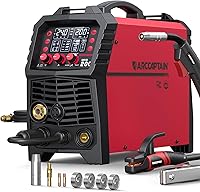
The ARCCAPTAIN MIG200 covers a lot of that ground as a 6-in-1 unit. It runs on 110V or 220V and includes gas and gasless MIG, stick, spot and lift TIG modes, with a spool gun connector as an option.
Its synergic MIG setting matches current and wire speed to the wire diameter and gas you choose.
It stores 10 preset settings, which helps when you switch between jobs. The maker notes not to switch between 110V and 220V while the screen is on, so wait for it to power down first.
For a home shop that wants one machine for several processes, that flexibility is useful.
Does current type change how you set up gas and wire?
No, the current type doesn't change the gas or wire you choose for a given material. DC MIG with solid wire uses a shielding gas such as a mix of argon and CO2 for steel.
Flux-cored wire runs without gas and suits outdoor or windy spots.
What DC does affect is how smoothly the wire feeds and how much spatter you get. A steady arc lets you run the recommended wire speed without fighting the pool.
If you're new to the process, our guide to what a MIG welder is good for walks through which jobs suit solid wire versus flux core.
For a closer look at a popular beginner machine, the YESWELDER 160A MIG welder review covers its setup and where it fits. If you're comparing several units before buying, the roundup of the best MIG welders for home use lines up the main options by job.
Are there times when AC output makes sense?
AC output makes sense mainly for stick welding, not for MIG. Some electrodes run better on AC, and older or specialized machines offered it for that reason.
If you buy a multi-process welder that includes AC, treat it as a stick or TIG feature.
For MIG itself, DC is the practical default on nearly every machine sold for home use. Chasing an AC MIG setting rarely helps a home project.
The steadier arc and cleaner bead of DC are what you actually want on thin steel and light fabrication.
So when someone asks are MIG welders AC or DC, the useful answer is DC for the weld, AC for the wall. Check the output type and the amperage range, not just the input voltage.
That's the spec that shapes your results.
What should you check before you buy?
Confirm the output is DC and the amperage range matches your metal. Then check the input voltage against the outlet you'll use.
A 110V DC machine is the simplest start for thin sheet; a dual-voltage DC unit gives you room to grow.
If your budget is tight, the roundup of the best MIG welders under 500 covers machines that still run DC output. Pick a unit with synergic control if you're learning, and one with a spool gun option if aluminum is on your list.
Whichever you choose, the current type question has a short answer. MIG runs DC, and that's the reason the arc stays steady enough for thin work.
Match the machine to your metal and your outlet, and the rest is practice.
Frequently asked questions
Can a MIG welder run on AC current?
Some multi-process machines offer an AC output, but a dedicated MIG welder almost always runs DC. AC MIG exists in older or specialized units, and it tends to produce a harsher arc.
For home steel work, DC is what you want.
Why does DC give a smoother MIG weld?
DC keeps the current flowing one direction, so the arc stays steady and the wire melts at a consistent rate. That steady pool makes thin sheet easier to control.
AC reverses direction many times a second, which can cause more spatter and a rougher bead.
Does a 110V MIG welder run DC?
Yes, almost all 110V MIG welders output DC, even though they draw AC from the outlet. The internal power supply converts it.
The voltage of the wall supply tells you about input power, not the output type.
Do I need DC for welding aluminum with MIG?
MIG aluminum is typically done on DC with a spool gun and argon shielding gas. DC keeps the feed steady and the bead clean.
You do not need an AC output for most aluminum MIG work on a home machine.
Is DC or AC better for thin auto body panels?
DC is the better choice for thin panels. The steady arc lets you run short, cool stitches without burning through.
Many machines with synergic control make that even easier by matching voltage to wire speed.