Is a Wire Welder a MIG Welder?
Yes, a MIG welder is a wire welder, but not every wire welder does MIG. A MIG welder feeds wire and uses shielding gas, while a flux-cored wire welder feeds wire with no gas bottle.
On this page (11 sections)
- Is a wire welder a MIG welder, or something else?
- How do gas MIG and flux-cored wire differ in practice?
- Do I need a gas bottle to run a wire welder?
- What are the three main types of wire welder?
- Which machine handles a home project?
- Is a wire welder safe for a beginner?
- Can one wire welder do stick and TIG as well?
- Which small wire welder is the easiest to start with?
- What should you check before you buy?
- What do the small machines weld in real terms?
- The bottom line
Yes, a wire welder is a MIG welder in the loose way most shoppers use the term, and the two names are often swapped. The catch is that "wire welder" covers gas MIG and gasless flux-cored welding, and those are two different setups.
True MIG feeds a solid wire and shields the puddle with gas from a cylinder. Flux-cored wire feeding runs the same gun with no bottle at all.
That difference decides which machine fits your home project. A car panel fix wants gas MIG for a clean bead on thin steel.
A rusty trailer in the wind wants flux core, because the gas cloud would blow away. You can't always tell from the label "wire welder" which one you're holding.
Is a wire welder a MIG welder, or something else?
A MIG welder is a wire welder, but not all wire welders do MIG. Wire feeding just means a spool pushes filler through a gun, and that can be solid wire with gas or hollow flux-cored wire without it.
In welding, MIG stands for metal inert gas. Solid wire melts under a cloud of argon blend or carbon dioxide, and that gas keeps oxygen out of the puddle.
Pull the gas away and the weld turns porous.
Flux-cored arc welding is the gasless cousin. The wire has flux packed in its core, so it shields itself as it burns.
Many hobby machines run both, which is why the names get tangled on the box.
How do gas MIG and flux-cored wire differ in practice?
Gas MIG gives a cleaner weld on thin steel, and flux core saves the bottle for outdoor work. Pick gas MIG for body panels and sheet; pick flux core when wind, dirt or a tight budget is in play.
Gas MIG leaves little slag, so cleanup is quick. It hates breezes, because even a slight draft strips the shield from the puddle.
Flux core leaves a crust you chip off, but it shrugs off wind. It also tolerates light rust and mill scale, which helps on old farm and trailer steel.
Flux core also feeds slightly less smoothly on a bare-bones drive system. The YESWELDER 135A has a upgraded drive system aimed at stopping wire jams, per the brand.
Do I need a gas bottle to run a wire welder?
Only a true MIG setup needs shielding gas, and a dual-purpose machine runs gasless out of the box. That's why the "wire welder" label sells so widely to home users: you can weld the same day.
Buying a bottle adds cost and a refill trip. It also ties you to one source for gas.
Rent or buy the cylinder, plus a regulator, and keep the tank upright.
If you expect to move the welder outdoors, gasless is the safer default. If your projects are body panels and clean bench work, plan for gas.
The Lincoln Electric Easy MIG 140 runs both MIG and flux core, with a 30 to 140A output range and 0.025 to 0.030 in wire. It weighs 62 lb, so it stays on a cart.
What are the three main types of wire welder?
MIG, flux core and multi-process wire machines cover the hobby market. Each one feeds wire, but they suit different jobs.
- MIG uses solid wire and a gas shield, best for clean, thin steel and some aluminum.
- Flux core uses hollow wire and no gas, best for outdoor steel and beginner work.
- Multi-process adds stick and lift TIG on top of the wire modes, which suits a shop that welds mixed metals.
Multi-process adds flexibility, but every extra mode is one more thing to learn. Most home users start with a small wire machine and stop there.
Which machine handles a home project?
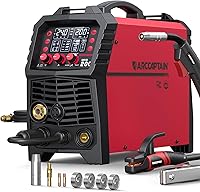
Match the machine to the thickest steel in the project and to whether you have a gas source. The ARCCAPTAIN 165A covers gas MIG, flux core, lift TIG and stick, so it switches modes for the job.
It handles mild steel up to 3/16 in.
Buyers often ask what a MIG welder is good for before they commit. For a home project, the answer is clean work up to about 3/16 in on 110V, plus stick on thicker steel with the multi-process models.
The ARCCAPTAIN 165A runs on 110V or 220V with a 165A output and a 60% rated duty cycle. It weighs 10 lb.
It takes 2 lb wire spools only, so plan on buying refills in that size.
Is a wire welder safe for a beginner?
Yes, a small flux-cored machine is one of the friendlier welders to learn on, with the right safety gear. The wire burns hot and spits spatter, so cover up.
Wear a welding helmet, gloves, and sleeves, and clear the bench of anything that can catch a spark. Vent your work area, especially with flux core, which gives off more smoke.
The YESWELDER 135A runs synergic control, which sets the voltage for your wire feed speed. That takes some guesswork out for a first-time welder chasing thin steel.
The ARCCAPTAIN 165A has 2T and 4T trigger modes, so you can switch between trigger control and continuous welding. Both makers build in over-current, over-load and over-heating protection.
Can one wire welder do stick and TIG as well?
Yes, a multi-process wire welder adds stick and lift TIG, but the wire modes stay the core job. Stick handles thicker, dirtier steel; lift TIG shines on thin, clean work.
You'll need extras for the other modes. The ARCCAPTAIN 165A needs a WP-17V TIG torch bought separately for lift TIG, and the YESWELDER 135A also needs an extra lift TIG torch.
That's the trade-off: one box, but a few add-ons before every mode works. For pure wire work, a dedicated MIG machine is simpler.
Which small wire welder is the easiest to start with?
For a first machine on a tight budget, the gasless YESWELDER 135A keeps the setup short. It runs flux core, stick, and lift TIG, and the box includes flux core wire.
If you need 220V power or want to weld thicker steel, the ARCCAPTAIN 165A gives you the higher output and the voltage switch. If you want a known brand with a full MIG and flux setup and a strong feed control, the Lincoln Easy MIG 140 is a steady pick.
For a wider field, see our picks for the best MIG welder for home use or the best MIG welder under 500. To judge a single machine in detail, the YESWELDER 160A review walks through a step-up model.
What should you check before you buy?
Check the power voltage, the thickness rating, the wire spool size and the modes you actually need. Those four facts answer the is a wire welder a mig welder question for your own bench.
Input voltage caps the current. A 110V machine welds thin steel fine and labors on thick plate; a 220V or dual-voltage unit gives more headroom.
The spool size sets your refill habit. The ARCCAPTAIN 165A takes 2 lb spools only; the YESWELDER 135A includes 1 lb spools of .030 and .035 in wire, and the machine accepts a standard small spool at that size.
Modes decide extras. If you want gas MIG, plan for the bottle and regulator.
If you want stick, choose a multi-process box. Match the mode list to real projects, not to the biggest spec sheet.
Finally, weigh the machine. The Lincoln Easy MIG 140 is 62 lb and stays put; the YESWELDER 135A is 11.4 lb and moves with you.
What do the small machines weld in real terms?
These 110V wire welders suit thin and light plate, mostly 3/32 to 3/16 in mild steel. The Lincoln Easy MIG 140 is rated from 24 gauge up to 3/16 in on mild steel.
The ARCCAPTAIN 165A handles mild steel up to 3/16 in. The YESWELDER 135A is rated for mild steel up to 3/32 in (2.5 mm).
That covers auto body panels, brackets, gates and light trailer work. For thicker steel, you need the stick mode or a bigger machine.
The Lincoln also lists aluminum and stainless capability with the right wire. Gas MIG handles aluminum on some machines with a spool gun; flux core is a steel process.
If you want a broader picture, read what a MIG welder is good for before you pick a material.
The bottom line
A wire welder is a MIG welder whenever it runs solid wire under a gas shield, which is what shoppers mean most of the time. A gasless flux-cored box is still a wire welder, just not a gas MIG welder.
That's the whole answer to is a wire welder a mig welder, and the machine label tells you which one you're getting.
For most home projects, start with a dual-purpose 110V machine and add gas when the job calls for clean, thin work. The YESWELDER 135A is the low-cost way into gasless and stick.
The ARCCAPTAIN 165A gives you 220V and thicker steel. The Lincoln Easy MIG 140 brings a full MIG setup and steady wire feed.
Pick the one whose modes match your next project, then buy wire in the spool size it takes.
Frequently asked questions
Do I need shielding gas to run a MIG welder?
Only for true MIG welding. A dual-purpose machine can run gasless flux-cored wire with no bottle, which suits outdoor work and simple garage projects.
Gas MIG gives a cleaner bead on thin sheet metal, but you must buy or rent a cylinder and regulator.
What is the difference between MIG and flux-cored wire?
MIG wire is solid and relies on a gas cloud to protect the molten pool. Flux-cored wire is hollow and carries its own shielding inside, so it burns without a gas bottle.
Flux core runs fine in wind and handles dirty metal, while MIG gives less spatter.
Can a wire welder weld aluminum?
A gas MIG setup can weld aluminum with the right wire and a spool gun on many machines, though it takes practice on thin sheet. Flux-cored wire is for steel, and a basic gasless machine won't touch aluminum well.
Ask the seller about a spool gun before you plan an aluminum job.
Is stick welding a wire welding process?
No. Stick welding uses a coated electrode rod that melts into the joint, not a spool of wire fed through a gun.
Some multi-process machines switch between MIG, flux core, lift TIG and stick, which is why they carry more than one mode.
How thick steel can a small wire welder handle?
The Lincoln Easy MIG 140 is rated for mild steel from 24 gauge to 3/16 in. The ARCCAPTAIN 165A handles up to 3/16 in mild steel, and the YESWELDER 135A up to 3/32 in (2.5 mm).
Thinner metal suits these 110V machines better than heavy plate.