What Gas Do MIG Welders Use?
MIG welders use argon and carbon dioxide, usually as a mix for mild steel. Typical choices are 75% argon with 25% CO2 for general steel, argon with 2 to 5% CO2 for stainless, and pure argon for aluminum.
On this page (8 sections)
- What type of gas do MIG welders use for mild steel?
- What gas do MIG welders use for stainless steel?
- What gas do MIG welders use for aluminum?
- What does each shielding gas do to the weld?
- Which gas should you choose for your MIG welder?
- Do you need a regulator and flow gauge for MIG gas?
- How do you set gas flow and avoid common mistakes?
- Which MIG welder fits your gas setup?
MIG welders use argon, carbon dioxide, or a mix of both to shield the molten weld from the air. The right choice depends on the metal: an argon and CO2 mix for mild steel, a leaner argon mix for stainless, and pure argon for aluminum.
That answers what type of gas do MIG welders use at the simplest level.
A gas shielded MIG welder feeds solid wire and blows gas out of the nozzle at the same time. The gas pushes oxygen and nitrogen away so the weld stays clean.
Flux core wire does this job itself, which is why the MIG vs flux core welder decision comes first.
What type of gas do MIG welders use for mild steel?
Mild steel takes an argon and carbon dioxide mix, most often 75% argon to 25% CO2. That blend gives a stable arc, a clean bead, and enough penetration for sheet, tube and general fabrication.
The CO2 does the heavy lifting on penetration. More CO2 means a hotter, deeper weld, which suits thicker steel.
More argon means a smoother arc and less spatter, which suits thin metal and vertical work.
You'll see this blend sold as C25 or "MIG mix" at welding suppliers. It's the standard choice for hobby and shop work on carbon steel.
Pure CO2 also works on mild steel and costs less, but the arc is harsher and the spatter heavier.
For thin sheet, a mix with more argon keeps the arc cooler and reduces burn through. That's a big reason the mix outsells pure CO2 for home welding.
What gas do MIG welders use for stainless steel?
Stainless needs argon with 2 to 5% CO2, or a small amount of oxygen in place of the CO2. The low CO2 level protects the chromium in the steel so the weld doesn't rust.
Too much CO2 in stainless causes carbon pickup at the weld, and the joint can corrode later. A blend labeled for stainless, such as 98% argon and 2% CO2, avoids that problem.
Some suppliers offer a three-part mix with a little helium for better wetting.
Keep the heat low and move steadily on thin stainless. The gas protects the puddle, but too much current still overheats the metal and burns the alloying elements out of it.
Stainless is the case where the gas matters most. A C25 blend that's perfect on mild steel will leave a stainless weld looking gray and ready to rust.
What gas do MIG welders use for aluminum?
Aluminum takes 100% argon. Argon gives the cleaning action that breaks up the oxide layer on aluminum, and CO2 doesn't do that job.
Aluminum also needs a spool gun or a push-pull gun on most machines, because the soft wire kinks in a long standard liner. The Millermatic 211 PRO detects a spool gun when you connect one and switches over.
Pure argon runs hotter on aluminum than a mix would on steel, so travel speed and current need more care. Thin aluminum warps quickly, so practice on scrap before you commit to a part.
You can also weld aluminum with flux core or stick in some setups, but gas MIG with pure argon gives the cleanest look on thin sheet.
What does each shielding gas do to the weld?
Argon stabilizes the arc and cleans the puddle, while CO2 adds penetration and heat. The ratio you choose moves the weld between those two behaviors.
Argon alone gives a smooth, quiet arc. It's the base gas in nearly every MIG mix.
CO2 is cheaper per cylinder and boosts penetration, but it spatters more and gives a rougher finish. Helium, used in some stainless and aluminum mixes, adds heat for thicker sections.
- Argon and CO2 mix: all-round choice for mild steel.
- Pure CO2: cheap, deep penetration, more spatter, mild steel only.
- Argon plus 2 to 5% CO2: stainless steel.
- Pure argon: aluminum.
- Argon and helium: thick aluminum and some stainless jobs.
The gas affects the weld's look as much as its strength. A mix tuned for thin steel leaves a flatter, cleaner bead than pure CO2 on the same joint.
Which gas should you choose for your MIG welder?
Choose a 75/25 argon and CO2 mix if you weld mild steel and want one cylinder to do most jobs. That covers the widest range for a home shop.
Pick pure argon only when you also weld aluminum or stainless regularly.
Your machine's manual states which gases it supports, and the regulator and hose need to match the cylinder fitting. Most suppliers swap cylinders by the size, not the mix, so decide on the blend before you buy the cylinder.
If you weld outside or in a draft, flux core wire is the more reliable option. Gas blows away in the wind and leaves a porous weld.
Check whether you can you use gasless wire in a gas MIG welder before you buy a second setup.
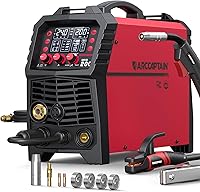
A four-in-one machine gives you the flexibility to switch between gas and flux core as the job changes. {{product B0BX3VRGW3 | A 4-in-1 unit with gas MIG, flux core, stick and lift TIG modes, so you can match the process to the job and the gas you have.}} It runs on 110V or 220V and weighs 19.4 lb.
{{product B0F89XL34N | A light 12.8 lb 4-in-1 machine for gas or flux core MIG, with an LED screen and a 60% duty cycle at 165A.}} Its manual control and synergic modes both cover gas MIG work.
Do you need a regulator and flow gauge for MIG gas?
Yes, every gas cylinder needs a regulator and a flow gauge. The regulator drops the cylinder pressure to a usable level, and the gauge shows the flow in cubic feet per hour (CFH).
Set the flow to about 15 to 20 CFH for indoor welding. Go a little higher in a draft or with a long gun lead.
A gauge that sits at zero while the trigger is pulled means the gas isn't reaching the weld.
The regulator connects to the cylinder with a threaded fitting that varies by supplier. Check the fitting type before you rent or buy a cylinder.
The Millermatic 211 PRO includes a flow gauge regulator and gas hose for argon or an argon and CO2 mix.
Watch the gauge as you weld. A dropping needle means the cylinder is running out or the regulator is icing up.
Warm the regulator slowly if it frosts over on a cold day.
How do you set gas flow and avoid common mistakes?
Start at 15 to 20 CFH and adjust in small steps while you watch the bead. A clean, quiet puddle with no porosity means the flow is about right.
A sputtering, gray weld means it's too low.
Common mistakes are easy to spot once you know what to look for:
- Too little gas leaves a dull, porous weld and a popping sound.
- Too much gas wastes the cylinder and can stir air into the puddle, causing porosity anyway.
- A blocked nozzle traps spatter and stops the gas reaching the weld. Clean it between sessions.
- Welding in a breeze blows the shield away. Move indoors or put up a screen.
- The wrong gas for the metal gives a rough bead, poor penetration, or corrosion later.
Purge the line for a second before you strike an arc so the gas reaches the nozzle. Keep the gun at a steady angle and don't pull the trigger until you're in position.
These small habits cut gas waste and improve the bead.
Which MIG welder fits your gas setup?
Pick a machine that supports the gas you plan to use and has the duty cycle for your work. A gas-capable welder needs a gas valve, hose and regulator, and not every budget machine includes them.
The YESWELDER 160A covers gas MIG, flux core, stick and lift TIG, with synergic control that sets voltage and wire speed when you choose a thickness. That makes it easy to get started with a C25 cylinder.
For a lighter wallet, the mig welder under 500 options still handle gas MIG on mild steel.
The Millermatic 211 PRO runs on 120V or 240V and includes a gas regulator and hose. It also has Auto-Set, which sets the parameters once you choose material, gas type and thickness.
That takes the guesswork out of matching the gas to the job.
For a home shop, a compact 110V machine with a gas valve is often enough. See the mig welder for home use picks for machines sized to a garage outlet.
The right gas setup comes down to three questions: what metal you weld most, what your machine supports, and whether you have room for a cylinder. Start with a 75/25 mix for mild steel, then add a second cylinder only when stainless or aluminum becomes routine.
That is the practical answer to what type of gas do MIG welders use.
Frequently asked questions
Can you MIG weld without gas?
Yes, with flux core wire. That wire carries its own flux and makes its own shielding, so no gas cylinder is needed.
It's the usual choice for outdoor or windy work, but it leaves slag you have to chip off between passes.
Is 100% CO2 good for MIG welding?
It works for mild steel and gives deeper penetration than argon mixes. The trade-off is more spatter and a rougher bead, so it suits thick steel more than thin sheet.
Many hobbyists start with an argon and CO2 mix instead.
Can I use argon with flux core wire?
No. Flux core wire doesn't need external gas and runs without a cylinder.
Leave the gas off and switch the machine to flux core mode.
See our guide on whether you can use gasless wire in a gas MIG welder for the settings side.
Why does a MIG weld look dull and sooty?
That usually means the gas flow is too low, the nozzle is blocked, or you're welding in a breeze. Check the regulator, clean the nozzle, and shield the work.
Gas that's too low also leaves porous, weak welds.
How much gas should a beginner set on a MIG welder?
Start around 15 to 20 cubic feet per hour for indoor work. Raise it a little for drafts or a longer gun lead.
Too much wastes gas and can stir the air into the weld, so adjust in small steps while watching the bead.