Can You Use Gasless Wire in a Gas MIG Welder?
Yes, you can use gasless flux core wire in a gas MIG welder, but only after you switch the polarity to flux core and turn the gas supply off. A machine set up for gas wire runs the opposite polarity, so welding with flux core on a gas setup gives poor, spattery results.
On this page (9 sections)
- What is gasless wire and why does polarity matter?
- Can a gas MIG welder run flux core wire?
- How do you switch a gas welder over to flux core wire?
- Which wire and settings do you need for flux core?
- Can you run gasless wire with the gas left on?
- How does flux core compare with gas shielded MIG?
- What problems happen when you mix wire and gas setups?
- Can you use gasless wire for aluminum or stainless?
- Is gasless wire in a gas MIG welder worth the swap?
Yes, you can use gasless flux core wire in a gas MIG welder, but only after two changes. Set the polarity for flux core and turn the gas supply off.
That matters because "gasless wire in a gas MIG welder" isn't just a spool swap. The machine's wiring and gas plumbing have to match the wire, or the weld suffers.
What is gasless wire and why does polarity matter?
Gasless wire, also called flux core wire, carries its own shielding inside the wire. The hollow center holds flux that burns into a protective gas cloud as the wire melts.
That means you don't need a gas cylinder. The trade-off is more spatter and smoke, and the weld puddle needs cleaning afterward because flux leaves a crust called slag.
The big difference is polarity. Gas shielded solid wire runs electrode positive, with the torch lead on the positive terminal.
Flux core wire runs electrode negative, with the torch lead on the negative terminal.
Wire your torch positive for flux core and the arc runs hot and unstable. You get spatter and poor penetration.
So the first step in any gas to gasless switch is checking the terminals.
Can a gas MIG welder run flux core wire?
It can if it has reversible polarity. Most MIG welders with gas capability label the two output terminals and let you swap the torch and ground leads.
Check the inside of the wire feed compartment or the front panel. Look for two terminals marked positive and negative, often with a polarity diagram for solid wire and flux core.
If the torch lead is fixed and only the ground lead moves, or there is no polarity diagram, the machine may be gas-only. In that case, gasless wire won't run right and you should stick with solid wire and gas.
Dual-purpose machines are common. The MIG vs flux core welder comparison walks through which setup suits which job.
How do you switch a gas welder over to flux core wire?
Change polarity, remove the gas line, and load the spool. Do each step with the machine unplugged and the cylinder valve closed.
- Shut off the gas at the cylinder and bleed the regulator.
- Unplug the welder and open the side panel.
- Swap the torch and ground leads so the torch is on negative.
- Fit a flux core drive roller if the wire size needs it.
- Load the flux core spool and set tension.
- Thread the wire, fit the flux core nozzle, and test on scrap.
Keep the gas hose capped or tied back so it doesn't snag. Turn the gas solenoid setting off if your machine has one.
Load the spool so the wire feeds off the top and into the liner without kinks. Set the drive roller tension so the wire doesn't crush; flux core wire is hollow and dents easily.
Which home welder makes the switch easy?
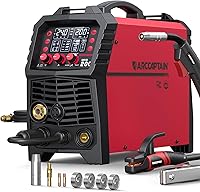
The ARCCAPTAIN 165A MIG Welder runs gas MIG, flux core MIG, Lift TIG and stick, so one machine covers both wire types. Its dual 110V/220V input and LED display help you set synergic or manual parameters.
It reaches 165A with a 60% duty cycle and handles mild steel up to 3/16 in thick. The package includes a .035 in 2 lb spool of flux core wire, a MIG torch and a .030/.035 in roller.
It holds only a 2 lb spool, so plan on buying wire more often. For a larger spool or aluminum work, the LOTOS MIG225SP is the step up.
Which wire and settings do you need for flux core?
Match the wire size to the metal thickness and set the machine for flux core. The flux core nozzle is wider and should sit a little further from the work than a gas nozzle.
Use E71T-GS flux core wire for thin sheet and general home work. It runs well at low current and suits 18 to 14 gauge steel on a small machine.
Set the wire feed speed and voltage from the chart for your wire diameter and metal thickness. Run a test bead on scrap before you touch the real part.
Keep the gun angle around 10 to 15 degrees of push. Flux core doesn't like a drag angle the way some stick welding does.
Clean the slag after each bead with a chipping hammer and brush. That step matters on thin panels where slag can hide a cold lap.
Who should choose the YESWELDER 135A?
The YESWELDER 135A MIG Welder is a 3-in-1 unit for flux core MIG, stick and Lift TIG on 110V. Its synergic control matches voltage to wire feed speed, which helps beginners avoid burn-through on thin panels.
It handles mild steel up to 3/32 in and weighs 11.4 lb. The box includes E71T-GS flux core wire in .030 and .035 in.
A Lift TIG torch is sold separately.
It's a flux core machine first. For a MIG welder for home use that switches between gas and gasless more freely, look at the ARCCAPTAIN.
Can you run gasless wire with the gas left on?
No, turn the gas off. Shielding gas and flux core shielding fight each other.
The gas stream can push the flux cloud away from the puddle.
The weld can turn porous, and you burn cylinder gas for nothing. Close the valve at the bottle and disconnect the hose when you switch to flux core.
Some machines have a gas solenoid that opens only in MIG mode. Even so, shut the cylinder valve so the regulator isn't left pressurized.
If you forget and weld flux core with gas flowing, the bead usually looks rough and sooty. Re-run the joint after you fix the setup.
How does flux core compare with gas shielded MIG?
Gas shielded MIG gives cleaner welds; flux core wins on portability and outdoor work. The choice usually comes down to where you weld and how thick the metal is.
Gas MIG with solid wire produces less spatter and less smoke. It handles thin sheet well and leaves no slag to chip.
Flux core is better in wind, on rusty or painted metal, and where hauling a cylinder is a hassle. It also runs at lower current on small machines.
On thick steel, gas shielded MIG usually gives tougher welds. Flux core earns its keep on fences, trailers and farm repairs.
Wire cost per pound runs higher for flux core because of the flux fill. You save on bottle rental and gas refills.
Who should choose the LOTOS MIG225SP?
The LOTOS MIG225SP is a 6-in-1 machine for gas MIG, flux core, spool aluminum, stick, Lift TIG and spot. It comes with an aluminum spool gun and runs on 110V or 220V.
It reaches up to 225A and handles steel from about 18 gauge to 2/5 in in multi-pass. The auto-synergic MIG setup and LED screen speed up changes between processes.
It weighs 30 lb and needs a NEMA 6-50 plug for 220V. A Lift TIG torch and argon regulator are not included.
If your budget is tighter, our list of MIG welders under 500 covers smaller gas and gasless options.
What problems happen when you mix wire and gas setups?
Most problems trace back to polarity or gas flow. Check those two first before you blame the wire or the machine.
Common signs and fixes:
- Rough, spattery bead: torch is still positive for flux core. Swap leads.
- Porous weld: gas is still on or the flux cloud is being blown away. Shut the gas and move out of the wind.
- Wire jams: roller tension too tight or the wrong roller size. Loosen and match the roller.
- Poor penetration on thick steel: current too low. Check the thickness chart and duty cycle.
Clean the contact tip and nozzle after each session. Flux core leaves more spatter, and a clogged nozzle changes the gas or flux flow.
Can you use gasless wire for aluminum or stainless?
Flux core wire is made for carbon steel, so don't use it on aluminum. Aluminum needs gas shielded MIG with a spool gun or TIG.
Stainless flux core wire exists, but it's less common and needs its own settings. If you want to know can you weld copper with a MIG welder, the answer also depends on gas and wire choice.
Stick with flux core for mild steel. For aluminum, the spool gun on a multi-process machine is the practical route.
Is gasless wire in a gas MIG welder worth the swap?
It's worth it when you weld outdoors, on dirty metal, or away from a gas supplier. Otherwise, solid wire and gas give you cleaner results with less cleanup.
Use flux core for fence posts, trailer repairs and windy driveways. Switch back to gas wire for thin auto body panels and shop work where finish matters.
The main rules for gasless wire in a gas MIG welder are simple. Set the torch to negative, shut the gas off, match the wire to the metal, and chip the slag.
Check polarity every time you change wire, because a mixed setup is the most common cause of a bad weld.
The ARCCAPTAIN 165A is the easy pick for a home shop that wants both modes in one machine. The YESWELDER 135A suits flux core on thin steel and light duty.
The LOTOS MIG225SP covers aluminum and heavier work when you need more reach.
Frequently asked questions
Does gasless wire work in a welder built only for gas?
Only if the machine lets you reverse polarity. A gas-only MIG welder wires the torch positive for solid wire, and flux core needs the torch negative.
Without a polarity switch or swappable leads, you can't run gasless wire correctly.
What happens if I leave the shielding gas on with flux core?
The gas stream can disturb the flux core's own shielding, pushing the protective cloud away from the puddle. You waste gas and the weld can turn porous.
Shut the cylinder valve and remove the hose before you switch to flux core.
Can I switch back to gas wire after using flux core?
Yes. Change polarity back to torch positive, fit the gas hose and regulator, and set the flow.
Clean the nozzle and contact tip first, since flux core leaves more spatter and dust than solid wire.
Why does flux core wire cost more per pound?
Flux core wire is hollow and filled with flux, so part of what you pay for is the flux compound rather than only steel. The trade-off is that you skip the bottle rental and gas refills.