Can You Weld Cast Iron With a TIG Welder?
Yes, you can weld cast iron with a TIG welder, using nickel or nickel-iron filler and a DC setup with slow, even heat. It works best on small repairs and cracked castings, not on large, oily or heavily stressed parts.
On this page (9 sections)
- How does TIG welding cast iron actually work?
- What filler rod and settings do you need for cast iron?
- Can you weld cast iron with an AC/DC TIG machine?
- How do you prepare cast iron before TIG welding it?
- Can you weld cast iron without preheating it?
- What safety gear do you need for cast iron TIG work?
- Is TIG the best way to weld cast iron?
- Which jobs should you leave to a specialist?
- So, can you weld cast iron with a TIG welder?
Yes, you can weld cast iron with a TIG welder. It's a slow, controlled process with nickel or nickel-iron filler and a DC setup, and it works best on small repairs like cracks in a vise, a manifold flange or a machine base.
Large, oily or heavily stressed castings are where TIG gets hard.
The catch is that cast iron is not steel. It holds heat unevenly, it's brittle, and it can crack again as the weld cools.
TIG gives you the fine amperage control that helps, but the preparation and the cooling matter as much as the torch.
How does TIG welding cast iron actually work?
TIG melts the filler rod with an electric arc under argon, so you can dial the heat down to a trickle. On cast iron, that control is the whole point.
The arc is stable at low amps, and you can add filler in small dabs instead of laying a heavy bead.
Cast iron has high carbon in it, and quick heating or cooling makes the metal hard and crack-prone around the weld. TIG lets you keep the heat local and move slowly.
That's why it suits thin sections, corners and cracks where a stick electrode would blow a hole.
You weld cast iron on DC straight polarity, just like steel. The torch stays in one hand and the nickel filler in the other.
Compared with MIG welding, TIG is slower but far more precise, which matters on a 1/4-inch casting you don't want to distort.
One more thing in TIG's favour is the clean arc. There's no flux and no spatter to chip off afterwards, and on a fine crack in a machined surface that saves you finishing work.
The weld also stays workable, so you can file or machine it back close to the original shape.
What filler rod and settings do you need for cast iron?
Use nickel or nickel-iron filler rod and start around 60 to 80 amps on thin castings, then raise it slowly. The weld should look wet and flow into the crack rather than pile up on top.
Nickel filler is the usual choice because it stays soft and machines close to the base metal. Plain steel rod is cheaper, but the weld gets hard and can crack as it cools.
A nickel-iron rod sits in the middle: easier to machine than steel and less expensive than pure nickel.
Set the machine to DC, straight polarity, with argon as the shield gas. Keep the arc short and let the puddle form before you add filler.
For thin castings, run lower amps and pause to let the part cool between short beads.
One practical trick is to run a small test bead on a scrap piece of the same casting first. It tells you whether the metal is grey iron or something harder before you commit to the repair.
If the test bead cracks as it cools, the part needs more preheat or a different filler.
Matching the rod to the repair
Pure nickel rod is the safe default for cracks that need to be machined flat afterwards. Nickel-iron rod is a better match when you want a closer color and a slightly stronger joint.
Steel rod only makes sense on low-stress cosmetic work.
Can you weld cast iron with an AC/DC TIG machine?
Yes, and an AC/DC TIG welder is the more useful machine to own, because it also handles aluminum. Cast iron itself runs on DC, but the AC side opens up a second material for the same box.
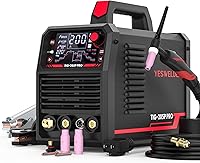
The LOTOS TIG200ACDC is a 200A AC/DC square-wave inverter with a foot pedal and an argon regulator, and it also runs DC stick. The foot pedal matters here: on a casting you want to ease the amps down as the puddle grows, and a pedal does that better than a torch switch.
The ARCCAPTAIN AC/DC TIG 200A adds pulse and a square and triangular waveform, plus a large LED display for the settings. Pulse helps on thin castings because it drops the average heat while the arc stays lit.
It also runs stick, which is the process many welders prefer on heavy cast iron.
If you're still deciding what to buy first, the best TIG welder for beginners is one that runs DC reliably before it adds AC.
How do you prepare cast iron before TIG welding it?
Grind the crack open to clean metal and remove every trace of oil, paint and rust. Cast iron is porous, and trapped oil bubbles up through the puddle and wrecks the weld.
- Clean the part with a degreaser, then grind a V-groove along the crack so the filler reaches the bottom.
- Chase the ends of the crack with a small drill so it can't keep running.
- Preheat thick parts to about 300 to 400°F with a torch, checking with a temperature marker.
- Clamp the part so it can't move as it heats, but leave room for it to expand.
Oil is the biggest enemy. A casting that has held oil, like a pump housing or an engine part, needs repeated heating and cleaning before the arc will behave.
If oil keeps boiling out, stop and clean again rather than trying to weld over it.
Can you weld cast iron without preheating it?
Yes, for small, thin repairs you can skip the preheat, and many home welders do exactly that. The key is to keep the heat low and let the part cool slowly in dry sand or a blanket.
Thick castings and stressed parts are different. A cold, thick part pulls heat away from the weld fast, and the metal around the bead hardens and shrinks.
That's where cracks start. Preheat gives the whole area a head start so the weld cools at a gentler rate.
Never quench a welded casting in water. Let it air-cool, ideally covered, for at least an hour before you touch it.
A slow cool is the cheapest insurance against a second crack. Peening the bead lightly with a chipping hammer while it's still warm also helps relieve the pull that causes cracking.
What safety gear do you need for cast iron TIG work?
You need a welding helmet that darkens as soon as the arc starts, because TIG arcs are bright and you'll be looking at them closely. A fixed-shade lens works, but an auto-darkening one makes low-amp work much easier.
The Hobart 770890 has a 9.3-inch widescreen viewing area and four arc sensors that trigger the lens at the strike of an arc. A large view helps when you're chasing a fine crack at low amps and need to see the puddle clearly.
It also has a grind mode, so you can switch to cleaning the casting without changing helmets.
The shade and sensitivity knobs on that helmet turn one setting at a time, so you can match the lens to the low amps a casting repair runs at. That matters more than it sounds: a lens set for thick steel stays too dark to follow a thin puddle.
Add leather gloves, a welding jacket and good ventilation. Cast iron dust from grinding and the fumes from hot oil are both worth avoiding, so work outdoors or with an extractor running.
Is TIG the best way to weld cast iron?
No, TIG is the best fit for small, precise repairs, not for every cast iron job. Stick welding with nickel electrodes is faster, more forgiving and better at burning through surface contamination on big, heavy castings.
Pick TIG when the part is thin, the crack is fine and you need a clean, machinable weld. Pick stick when the casting is thick, dirty or awkward to reach, and when speed matters more than a tidy bead.
Brazing is another option for parts that can't take welding heat at all.
If you already weld aluminum with TIG, the same process rules about cleaning and heat control carry over. And if you're weighing machines, MIG versus TIG is the comparison to read before you spend.
For aluminum on a MIG box, see can you weld aluminum with a MIG welder.
Which jobs should you leave to a specialist?
Leave engine blocks, cylinder heads and structural castings to a shop with cast iron experience. Those parts are large, oil-soaked and carry real stress, and a home TIG repair can fail without warning.
Small, low-stress parts are fair game: a cracked vise jaw, a bracket, a machine base or a decorative casting. If the part is safety-critical or expensive to replace, get a quote before you strike an arc.
So, can you weld cast iron with a TIG welder?
Yes, you can weld cast iron with a TIG welder, and it's a good choice for small, clean cracks where you need control. Use nickel filler, DC straight polarity, low amps and a slow cool-down.
For heavy or dirty castings, reach for stick instead.
Pick an AC/DC TIG machine like the LOTOS or the ARCCAPTAIN if you want one box for cast iron and aluminum. Pick the Hobart helmet if you want a wide, clear view for low-amp work.
And if the part is an engine block or a stressed structural casting, call a specialist rather than risk a second crack.
Frequently asked questions
Do you need AC or DC for cast iron TIG welding?
DC straight polarity does the job. Cast iron is a ferrous metal, so it welds on DCEN like steel does, and AC is the setting you reach for on aluminum instead.
What filler rod do you use to TIG weld cast iron?
Nickel or nickel-iron filler rod is the usual choice, and it machines and bends more like cast iron than a steel filler does. A plain steel rod can work on some repairs, but the weld gets hard and may crack when the part cools.
Is TIG the best process for cast iron?
No. TIG is the best choice for small, precise repairs where you can control the heat closely.
Stick welding with nickel electrodes is faster and more forgiving on large, heavy or dirty castings.
Should you weld a cracked engine block with TIG?
It's rarely the right first move. Engine blocks are large, oil-soaked and highly stressed, so machining or replacement is usually more reliable.
Take a block repair to a specialist with cast iron experience.