Do TIG Welders Need Gas?
Yes, a TIG welder needs shielding gas for TIG welding. Argon, usually pure argon, protects the molten puddle from air. Stick mode on the same machine runs without any gas at all.
On this page (8 sections)
- Do TIG welders need gas for every weld?
- When can you weld without gas?
- What gas does a TIG welder actually use?
- How much gas does a TIG welder use?
- What do you need to start TIG welding with gas?
- Which TIG machines suit a home shop?
- Do you need a bottle for aluminum TIG?
- Do TIG welders need gas: the short answer for buyers
Yes, a TIG welder needs gas for TIG welding. Pure argon shields the molten puddle from the air, and without it the weld oxidizes and fails.
But that yes comes with a big exception: the stick mode on many TIG machines runs with no gas at all.
So the real answer to "do TIG welders need gas" depends on which process you're running. TIG mode always needs a bottle, while stick mode never does.
That difference matters when you're picking a machine for a home project.
Do TIG welders need gas for every weld?
TIG welding always needs shielding gas. The TIG torch has no flux to protect the puddle, so gas from the bottle does that job instead.
Argon flows through the torch and forms a cone around the tungsten electrode. It pushes air away from the molten metal until the puddle freezes.
Cut the gas and the weld turns gray, porous and weak.
You'll see the gas line on the machine as a hose from the regulator to the torch. When you pull the trigger, gas flows before the arc starts and for a few seconds after it stops.
That pre-flow and post-flow timing protects the weld at both ends.
The arc itself is only heat. The shielding is a separate job that the gas does, which is why a TIG torch has a gas hose and a ceramic cup around the tungsten.
The cup holds the gas cone in place, and the tungsten has to sit at the right stick-out so the cone covers the puddle.
Every TIG-capable machine here needs a bottle attached for TIG mode. Plan for gas before you buy a TIG setup.
When can you weld without gas?
Stick mode on a TIG machine needs no gas. The electrode coating burns and creates its own shield, so the bottle stays off.
Most TIG welders include a stick (MMA) mode. That gives you a fallback for thick steel, rusty metal or outdoor work where wind would blow TIG gas away.
On the LOTOS, the stick side runs 15 to 200A DC and has adjustable hot striking current to help the arc start cleanly on different electrodes. That covers acid and basic electrodes, so you can match the rod to the job.
A lift TIG or scratch start torch is another story. Some multi-process machines run TIG with no high-frequency start, but they still need gas for the weld itself.
The lift only changes how the arc begins, not how the puddle is protected.
The ARCCAPTAIN MIG200 is an example, since its lift TIG option still needs gas when you switch to TIG mode. If your goal is to weld with no bottle at all, a flux core or stick machine is the simpler tool.
Our guide to TIG vs MIG welder covers that trade-off in detail.
What gas does a TIG welder actually use?
Pure argon is the standard choice for TIG work on steel, stainless and aluminum. It's the default in most home shops.
Argon gives a stable arc and good cleaning action on aluminum in AC mode. It's sold in cylinders from welding supply shops, usually in sizes from small portable bottles up to tall shop tanks.
Some welders use an argon and helium mix for thick aluminum, because helium adds heat to the arc. A small hydrogen addition helps stainless steel in some industrial settings, but most home users never touch it.
The gas choice also decides what the machine can do. Aluminum TIG needs an AC-capable machine, because AC breaks up the oxide layer while argon shields the puddle.
DC-only machines like the YESWELDER TIG-205P weld steel and stainless well, but no gas mix turns them into aluminum machines. Match the gas plan to the metal first, then the machine.
For the whole picture on how TIG fits with other arc processes, see is a TIG welder an arc welder.
How much gas does a TIG welder use?
A TIG welder uses gas slowly, typically 10 to 20 cubic feet per hour, set by the regulator flowmeter.
A small bottle lasts through a lot of light work at that rate. A 40 cubic foot cylinder handles a few hours of steady welding on thin metal, and a 125 cubic foot tank suits a busy home shop.
Flow rate is a setting, not a constant. Too little flow lets air reach the puddle, while too much wastes gas and can create turbulence that pulls air into the shield.
Set flow to the number your manual gives, often around 15 cfh, and adjust from there. A gas lens on the torch lets you run lower flow with a wider shield.
A longer gas hose between the regulator and the machine also lets you keep the bottle outside the work area, which matters on windy jobs.
What do you need to start TIG welding with gas?
You need a cylinder, a regulator, a hose and a torch, plus a machine with TIG output. Many TIG welders include the regulator, which simplifies the setup.
- The cylinder comes from a local welding supply shop, either bought or rented.
- The regulator steps the high tank pressure down to a steady flow.
- The hose carries gas from regulator to torch.
- The torch has the gas valve or a solenoid on the machine.
LOTOS builds this machine around aluminum, with a 200A AC square wave output and a foot pedal for heat control. It also runs DC stick at 15 to 200A for thick steel jobs.
The package includes the TIG torch, argon regulator, foot pedal and a 110/220V converter pigtail. The regulator in the box means you only need to source the cylinder and the fill to get welding.
What does the regulator in the box change?
An argon regulator is one of the smaller costs in a gas setup, but having it included removes a decision. You connect the cylinder to the regulator, run the hose to the machine, and set flow.
The regulator also gives you a flowmeter reading, so you can see when the bottle is getting low rather than finding out mid-weld. Check the regulator's fitting against the cylinder style your local supplier fills before you buy the bottle.
Which TIG machines suit a home shop?
The right machine depends on your metal. Aluminum needs AC output, while thin steel benefits from pulse control.
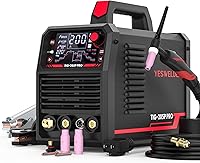
The YESWELDER TIG-205P runs DC TIG, pulse TIG and stick in one box. Pulse mode lets you set frequency, duty cycle and current independently, which helps on thin material.
It weighs 10.7 lb and has a 5-pin foot pedal interface if you add a pedal later. The auto memory function saves your settings and recovers them after a power-off, so you don't re-enter every dial after a break.
It cannot weld aluminum, so it's a poor fit if aluminum is on your list. For a wider range of home TIG machines, our roundup of the best TIG welders for beginners sorts them by use.
The ARCCAPTAIN MIG200 covers gas and gasless MIG, stick and lift TIG with a torch you add. Its spool gun connector lets you run aluminum wire in MIG mode with gas.
It's the pick when you want one machine that works without gas on some jobs.
For a stick-only option, read our ARCCAPTAIN stick welder review.
How does the ARCCAPTAIN handle gas and gasless wire?
The MIG200 takes solid wire with gas or flux core wire without it. Solid wire sizes run .023", .030" and .035", and flux core runs .030" and .035".
For aluminum wire in a spool gun, the machine accepts .035" and .040". The synergic control matches current and wire speed to the wire diameter you select, so switching between a gas bottle and a gasless spool is mostly a matter of changing wire and polarity.
Two notes to plan around: the .023" and .040" rollers are sold separately, and the TIG torch and spool gun are not in the box.
Do you need a bottle for aluminum TIG?
Yes, aluminum TIG always needs argon, and it needs an AC-capable machine. The gas and the AC mode go together.
Aluminum forms an oxide layer that melts hotter than the metal below it. AC TIG breaks that layer up while argon shields the puddle.
Skip the gas and the oxide stays, and the weld won't fuse.
Air-cooled torches work on thinner aluminum. Thicker sections push you toward a water-cooled torch and more gas flow, since the arc runs longer.
| Product | Best for | Our score |
|---|---|---|
| LOTOS TIG200ACDC | aluminum TIG work | |
| YESWELDER TIG-205P | thin metal TIG work | |
| ARCCAPTAIN MIG200 | one-machine gas and gasless work |
If aluminum is your main goal, pick a machine with AC output and budget for a steady argon supply. DC-only machines like the YESWELDER can't do that job.
Do TIG welders need gas: the short answer for buyers
Do TIG welders need gas? Yes for TIG welding, where argon is not optional.
Stick mode on the same machine runs without it, so a dual-purpose welder gives you a gas-free fallback.
Pick the LOTOS if you want AC/DC aluminum TIG with the regulator and pedal in the box. Pick the YESWELDER if you weld thin steel and stainless and want pulse control in a light machine.
Pick the ARCCAPTAIN if one machine for gas and gasless work matters more than aluminum TIG.
Before you buy, price a local argon cylinder and a fill. That gas cost is part of every TIG setup, and knowing it up front keeps the project on budget.
Also confirm your power: the LOTOS takes 110/120V or 220/240V on 50/60Hz and includes a converter pigtail, while the YESWELDER switches between 110V and 220V on its own. Decide which outlet in your shop will feed the machine before the box arrives.
Frequently asked questions
Do TIG welders need gas to run?
Yes for TIG welding, because the arc alone doesn't shield the puddle. Argon gas covers the molten metal so oxygen and nitrogen can't get in.
Stick mode on a TIG machine needs no gas.
How much does a TIG gas setup cost?
Budget for a cylinder deposit or purchase, a regulator, a hose and a gas fill. Many TIG machines include an argon regulator, which takes a chunk out of the starting cost.
Do you need gas for stick welding on a TIG machine?
No. Stick welding uses flux on the electrode to shield the weld, so the gas valve stays closed.
You can run stick with no bottle attached at all.